
Small Business Social Content No Longer Needs Design Skills
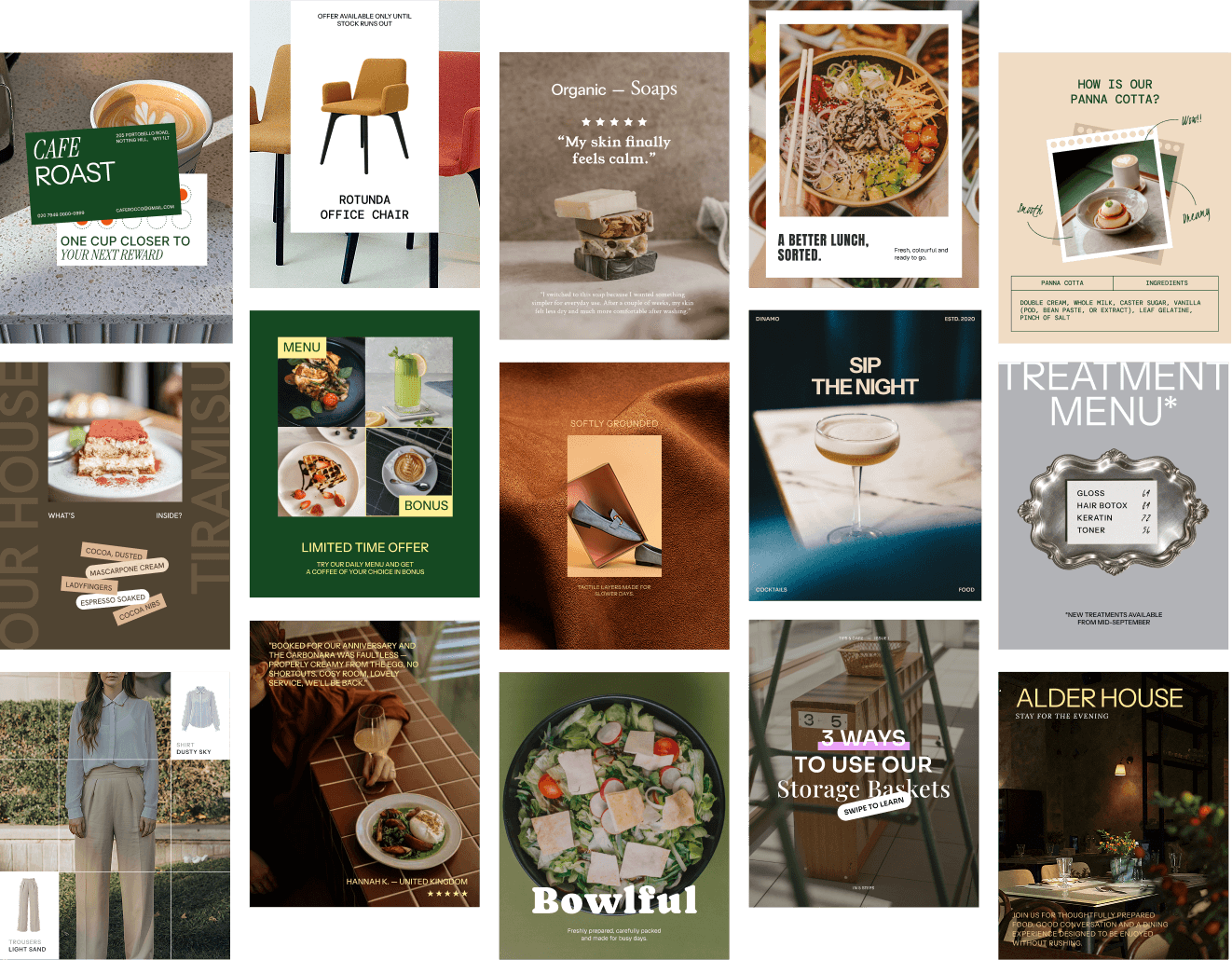
AI is reducing the specialist design skill, production time and budget needed to create polished social media content. Small businesses can increasingly start with an idea, template or their own photograph and produce credible finished creative without employing a designer for every asset. The person running the business still decides what is worth publishing.
A café owner should not need to understand typography and layout to turn a photograph of tomorrow's special into a good-looking promotion. A small fashion brand should not need an agency workflow every time it wants to announce a new product. Across Canva, Figma, Adobe, Google and newer platforms such as Asteris.ai, much of that production work is becoming accessible to people who would never describe themselves as designers.
Design used to have a toll
Small businesses have always been able to make their own marketing materials, but doing it well came with a cost. Someone had to learn the software, spend time arranging the design, work from a fairly rigid template or hand the job to a designer. Multiply that by the volume of visual material expected across social channels and the supposedly simple task of maintaining a good presence becomes surprisingly expensive.
That cost is particularly awkward because most social content has a short working life. A product announcement, restaurant special, event reminder or seasonal promotion might be relevant for days rather than months. Paying specialist rates for every asset rarely makes sense for a small business, yet publishing noticeably poor creative carries its own cost.
Several major product announcements in 2026 show how quickly software companies are attacking this gap. Canva AI 2.0, Adobe Express, Figma and Google's new Pics application are all putting more of the mechanics of professional visual creation behind natural-language instructions, templates and simplified editing tools.1234 Their approaches differ, but they are converging on the same practical outcome: people who need design can do considerably more without first becoming experts in design software.
This matters because small businesses rarely suffer from a shortage of things worth showing. Restaurants already have dishes, retailers already have products, salons already have client results and local businesses already have events, staff and stories. The production challenge has often been turning those raw materials into something polished enough to publish.
Prompts are learning design
Generating an image and designing a piece of content are different tasks. A useful social asset needs visual hierarchy, readable typography, balanced spacing, sensible cropping and enough room for the message to breathe. Early generative image systems could produce impressive pictures while leaving much of that work to the person using them.
Canva AI 2.0 shows how that distinction is starting to narrow. Canva says its Design Model understands the structure and hierarchy of real-world design and can generate layered, editable creative from a prompt.1 Instead of returning a single flattened image, the system can produce elements that remain editable, allowing users to continue changing the design after generation.
That detail is more consequential than another improvement in image quality. If the price on a promotion changes or the business owner dislikes the font, the design does not need to be regenerated from scratch. AI becomes part of an editable production process rather than a machine that delivers something visually impressive but difficult to correct.
Adobe is following a similar path with AI-powered conversational editing in Adobe Express. Its 2026 work allows users to describe changes in natural language while continuing to work with editable content and brand assets.3 For people without professional design training, asking software to adjust a layout or alter an element can be considerably easier than learning where every relevant control sits.
Google entered the same territory in September with Google Pics, a Workspace application for AI image creation and editing.4 Google positioned the product around helping business users make professional-looking visual material without requiring professional design expertise, adding capabilities such as object-level editing, editable text, translation, social-media cropping and upscaling.4 These tools are beginning to absorb some of the production knowledge that previously sat with the person operating the software.
Templates have not disappeared
Generative AI might appear to make templates unnecessary. Ask for whatever you want, generate it and move on. In practice, templates may become more valuable precisely because more people with limited design experience are creating content.
A blank prompt still asks the user to know roughly what a good design should look like. A professionally designed template makes many decisions before the user starts, including proportions, spacing, hierarchy and where imagery should sit. Instead of asking a non-designer to invent a composition, it gives them a credible structure to modify.
Figma Buzz is a useful example of this approach. Figma designed Buzz so teams can create social posts, digital advertising and other marketing assets from templates without requiring every user to work like a professional designer.5 The person creating the asset can change the content while the underlying structure and brand choices remain more controlled.
The significance becomes clearer when viewed alongside Figma's 2026 AI research. Its study drew on 8,403 survey responses and 639 qualitative interviews and found that the proportion of developers doing design work had risen from 44 per cent to 60 per cent, while the proportion of designers participating in development doubled to 41 per cent.2 The research is about product teams rather than small-business marketing, but it documents a wider erosion of the boundaries that used to keep specialist tasks inside specialist roles.
For a ten-person business, that shift has practical consequences. The person who understands a promotion best might be the shop manager, founder or employee dealing directly with customers, rather than someone with "designer" in their job title. Better templates and AI assistance allow more of the execution to stay with the person who already understands the message.
Small business is the obvious test
Canva made the small-business case particularly explicit with its 2026 work connecting Canva's design capabilities with Claude for Small Business.6 A business owner can move from company information or a rough brief towards branded campaign assets, including material for social channels and advertising.6 The premise reflects a familiar small-business situation: the owner understands what needs promoting but does not necessarily have the design resources or spare time to produce everything from scratch.
A restaurant may decide at 3 pm that it wants to promote unused tables that evening. A boutique might receive a product shipment in the morning and want to talk about it that afternoon, while a salon might have an unexpectedly free appointment it would like to fill. These are small creative jobs, but their value often depends on being able to execute them quickly.
Traditional creative processes are poorly matched to those situations. Even when professional design support is available, briefing, producing, reviewing and exporting an asset can take longer than the marketing opportunity itself. Software that collapses some of those steps changes which ideas are economically worth acting on.
Canva says AI usage on its platform has more than tripled over the past year.6 That points to AI-assisted design becoming part of ordinary creative work rather than an occasional experiment for early adopters. For small organisations where one person may move between operations, customer service, marketing and content creation during the same day, the value of reducing production friction is easy to see.
The competitive pressure is also visible among the largest creative-software companies. Reuters reported in September 2026 that Adobe was facing increased competition from AI-driven design challengers including Canva and Figma, even as demand for Adobe's own AI products continued to grow.7 Companies are increasingly competing on how widely they can distribute creative capability, rather than reserving sophisticated production tools for people with years of software experience.
Asteris removes another hurdle
Asteris.ai Templates applies the same shift directly to the everyday needs of small businesses. The newly launched offering allows someone to choose a professionally designed template, replace the supplied media with their own photographs, edit the text, images and layout directly in a browser, and download the finished creative without creating an account. That removes several barriers at once: design expertise, software installation, subscription cost and even account creation before the first piece of content can be made.
The free-access part matters because price is only one source of friction. Small-business owners already have accounting software, booking systems, ecommerce platforms, email tools and social accounts competing for attention. Asking somebody to create another account, learn another application and commit to a paid product can be enough to make a small creative task remain undone.
Templates offer a simpler entry point. Start from something that has already been professionally composed, put the business's own media into it and adjust what needs changing. The business can reach a polished result without beginning from either a blank canvas or a blank prompt.
Asteris also makes a deliberate choice about the source material. A restaurant can work with a photograph of the dish it actually serves, a salon can use the client result it actually produced, and a retailer can use product photography it already owns. The technology helps improve the presentation while the underlying content continues to represent the real business.
That distinction becomes more valuable as generating plausible-looking visual material gets cheaper. Small businesses do not necessarily need endless synthetic products, meals or locations that never existed. A more practical use of AI is helping them present the photographs, products, offers and stories they already have with considerably less production work.
Good taste gets more valuable
Lower production barriers do not guarantee better social media. They make technically competent content easier to produce, which means businesses will increasingly compete against a larger supply of visually polished material. Design quality by itself becomes less distinctive when almost anybody can reach a reasonable baseline.
Human judgement therefore moves higher up the process. Someone still has to decide which product deserves attention, which photograph feels authentic, how much text belongs on the image and whether the finished asset sounds and looks like the business. Those decisions depend heavily on context, taste and an understanding of the audience.
This is also why editability keeps appearing in the 2026 product announcements. Canva's emphasis on layered output, Figma Buzz's template model and Adobe Express's combination of conversational editing with manual control all leave room for a person to intervene.153 The software can remove increasing amounts of mechanical production work without needing to make every creative decision on the user's behalf.
For small teams, that is a more credible use of AI than replacing the creative function altogether. Most small businesses do not need to generate hundreds of anonymous assets. They need to make the pieces of content that genuinely matter without each one turning into a miniature design project.
The browser is becoming enough
A decade ago, producing polished visual content usually meant learning specialist software or finding somebody who already had. In 2026, a growing amount of everyday production work can begin with a sentence, a template or a photograph. The gap between having an idea and being able to present it professionally is becoming much smaller.
That changes the economics of social media content for small businesses. More ideas become worth trying because the cost of producing the creative around them falls. A timely promotion does not necessarily need to wait in a designer's queue, and a small experiment does not need enough expected revenue to justify an agency bill.
It also gives specialist designers more room to spend time on problems where their judgement genuinely matters. Brand systems, campaigns, creative direction and distinctive visual ideas still benefit enormously from expertise. Spending professional design time repeatedly resizing routine assets, changing dates or rebuilding near-identical promotional graphics becomes harder to justify when software can increasingly handle those tasks.
Canva, Figma, Adobe and Google are approaching this from different directions, while Asteris.ai Templates takes the same shift directly to small businesses with free browser-based editing. The result is not a world in which everybody suddenly becomes a designer. It is one where lacking design skills no longer has to stop a good business idea from becoming good-looking content.
Sources
Footnotes
Google Workspace, "Google Pics brings pro-level AI image creation and editing to Google Workspace", 1 September 2026. Google Workspace↩↩2↩3