
Stop Making Everything a Reel
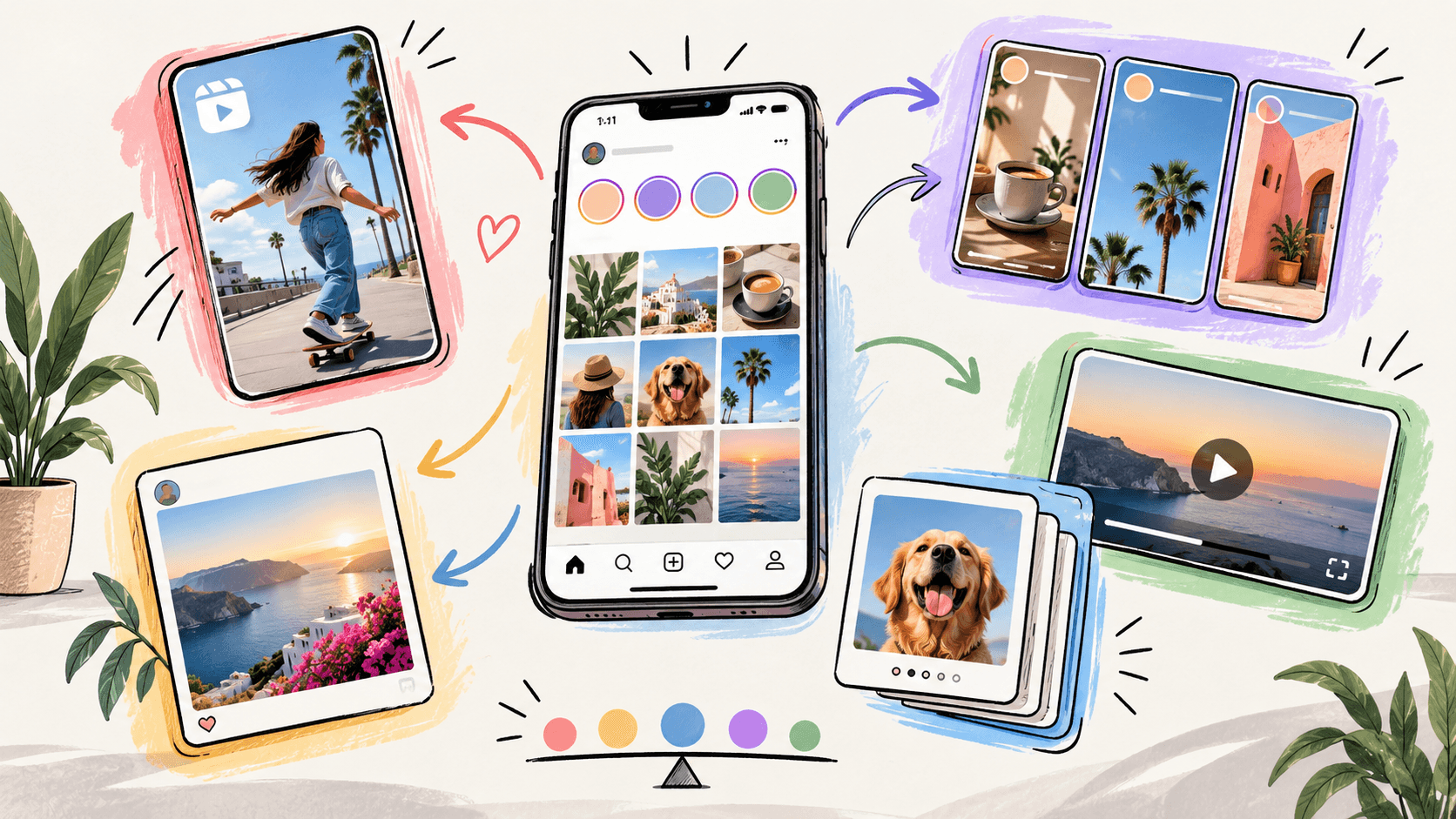
The best Instagram content mix for a small business in 2026 uses Reels for discovery, carousels for engagement, Stories for existing followers and single photos selectively. Each format does a different job. Choosing the format should follow the purpose of the post, not a blanket rule to make more video.
Instagram has spent years pushing video, so it is understandable that many small businesses now treat "make a Reel" as the default answer to almost every content question. The data in 2026 makes that advice look increasingly crude. A restaurant showing tonight's special, a salon explaining a colour correction and a clothing brand launching a new collection do not necessarily need the same format.
Give each format a job
There is no single best Instagram format because "best" depends on the result you are measuring. Buffer's 2026 analysis found that carousels produced a median engagement rate of 6.9% as a percentage of reach, ahead of single images at 4.4% and Reels at 3.3%.1 Yet its separate reach analysis found that Reels reached 36% more people than carousels and 125% more than single-image posts.1 A format that is best at finding strangers can therefore be weaker at getting the people it reaches to interact.
Socialinsider's 2026 benchmark study, based on 35 million Instagram posts, points in the same general direction despite using a different methodology. In Q2 2026, carousels averaged a 0.50% engagement rate, compared with 0.48% for Reels and 0.33% for images.2 Carousels also generated the most saves across account sizes in its dataset, while Reels produced more comments.2 The useful lesson is not that carousels have defeated video, but that different forms of attention are being created by different formats.
For a small business, that distinction matters because content production has a cost. Time spent editing a Reel is time that cannot be spent serving customers, taking photographs, answering enquiries or running the business. A sensible content plan therefore gives each format a clear job:
Once those jobs are clear, content planning becomes considerably easier. The question changes from "What should we post today?" to "What are we trying to make someone do or understand?" The answer often tells you which format to use before you have written a caption or opened an editing tool.
Photos still earn space
Single images are now the weakest format in several broad Instagram benchmark studies, but "weakest on average" is not the same as useless. Socialinsider recorded image engagement at 0.33% in Q2 2026, below both carousels and Reels.2 That is a good reason to stop turning every ordinary camera-roll image into a feed post, but it is a poor reason to stop publishing excellent photographs.
Some small-business content has an immediate visual payoff. A beautifully plated dish, a dramatic new haircut, a striking dress, a limited-edition product or a particularly good piece of customer photography may not benefit from seven extra slides or fifteen seconds of movement. If the photograph creates the reaction on its own, adding a format around it can become production for production's sake.
The standard for a single-image post should therefore be higher in 2026. The image needs to carry most of the communication before the caption is opened, which means framing, lighting, subject choice and recognisably branded visual style matter. A restaurant should favour the image that makes someone consider booking dinner, not the image that happens to be newest in the camera roll. A salon should show the finished work clearly rather than hiding it beneath text graphics that compete with the result.
Photos are also useful punctuation in a feed filled with motion and information. A small fashion brand might use a Reel to introduce a collection, a carousel to show several looks and then one exceptional editorial photograph as the visual statement of the campaign. The photo is doing less explanatory work, but more aesthetic work. That is a legitimate job, particularly for businesses where appearance is part of what customers are buying.
Carousels reward depth
The strongest argument for carousels in 2026 is not that Instagram users suddenly prefer slides. It is that carousels give a business enough room to make something useful without requiring the production effort of a video. Buffer's large 2026 study put carousels first for Instagram engagement, while Socialinsider found them leading both overall engagement and saves.12 That combination makes them particularly valuable when the content should be remembered, revisited or considered rather than consumed in a second.
A hair salon can turn one appointment into a carousel that opens with the final result, shows the starting point, explains the client's goal, reveals an intermediate stage and closes with care advice. A restaurant can show a finished dish, key ingredients, preparation and the chef behind it. An ecommerce brand can use five frames to show a product, a detail, scale, use and styling without asking a customer to decode all of that from one image.
This is where small businesses often have an advantage over large brands. They are close to the work itself, so they already possess the raw material for useful carousels: process photographs, customer questions, product details, before-and-after shots and practical expertise. The content does not need to imitate a corporate infographic. It can simply organise knowledge and media the business already has into an order that rewards swiping.
Carousels are also well suited to businesses that need to build confidence before a purchase. A £6 lunch special may sell from one good photograph, while an expensive colour treatment, handmade garment or specialist product may require more explanation. The additional frames create space for evidence, context and detail. That makes carousel performance especially interesting for small businesses where Instagram is part portfolio, part shop window and part proof of competence.
Reels find new people
Reels still deserve a substantial place in the plan because discovery remains their clearest advantage. Buffer's data shows significantly higher reach for Reels than both carousels and single images, and Instagram itself continues to connect Reels with audience growth in the Best Practices guidance available through professional dashboards.13 A business trying to reach people who have never heard of it should therefore think seriously about what can be shown through movement.
Movement needs a reason, though. A restaurant has flames, pouring, chopping, plating and a busy room. A stylist has transformation, technique and reveal. A fashion business has fabric, fit and movement on a person. These are naturally good video subjects because motion contributes information that a still photograph cannot provide.
Instagram's Trial Reels feature also reinforces the discovery role. Meta says Trial Reels can be shown to non-followers first, allowing creators to test an idea before deciding whether to share it more broadly.4 In data Instagram published in 2025, 40% of creators who tried Trial Reels began posting Reels more often, and among that group, 80% saw increased Reel reach from non-followers.5 Small businesses with access to the feature can use it as a testing mechanism rather than assuming every video deserves the main feed.
The mistake is equating a Reel with a mini advertisement. People can spot over-produced, interchangeable promotional video quickly, particularly as inexpensive AI tools make more of it possible. Footage from the business itself usually has more to say: a chef finishing a plate, a stylist working through a cut, a founder packing an order or a customer seeing the result. Tools such as Asteris can help turn a business's own photographs and footage into planned Instagram content, but the raw material should still look and feel like the business it represents.
Stories serve regulars
Stories occupy a different part of Instagram behaviour. Instagram head Adam Mosseri has described Stories as more suited to connecting with an existing audience than reaching large numbers of new people, with ranking influenced by signals such as taps, likes and replies.6 Hootsuite's 2026 Stories guide likewise emphasises their interactive features, including polls, questions, countdowns and links.7 That makes Stories less like another feed format and more like a lightweight daily communication channel.
This is particularly useful for small businesses because much of what customers genuinely want to know is temporary. A table has become available tonight, a new delivery has arrived, tomorrow's appointment has opened up, an item is nearly sold out or the team wants customers to choose between two colours. None of those necessarily deserves a permanent feed post. They make perfect sense as a Story because their value is tied to the moment.
Stories can also do something polished feed content struggles with: make the business feel occupied by actual people. A five-second look into the kitchen, a quick arrival of new stock or a stylist answering one customer question can create familiarity without requiring a full content production process. Polls and question stickers can also turn that familiarity into useful information about what customers want.7 For a small business, ten relevant replies can be more commercially useful than thousands of passive views.
The practical mistake is using Stories only to reshare feed posts. Repetition gives followers little reason to keep tapping. Stories work better when they carry information that is more immediate, conversational or participatory than the feed. A useful rule is that the feed shows what the business wants people to remember, while Stories show what is happening around the business now.
Build a format portfolio
A workable small-business Instagram plan in 2026 does not need equal quantities of all four formats. A restaurant with strong kitchen footage may reasonably publish more Reels, while a consultant-led beauty business with lots of educational material may get more value from carousels. A visually distinctive fashion brand may still have unusually strong single-image performance. Your own account data should eventually matter more than a platform-wide average.
Start by assigning an objective before assigning a format. If the goal is discovery, consider a Reel; if it is explanation or saving, build a carousel; if it is immediacy or conversation with existing followers, use Stories; if one image already says everything necessary, publish the photograph. That discipline prevents a simple idea from becoming a two-hour video edit because someone once said Instagram prefers Reels.
It also produces a healthier measure of performance. Comparing a Story designed to generate five appointment enquiries with a Reel designed to reach 20,000 non-followers makes little sense. Track reach for discovery content, saves and shares for useful carousels, replies and link actions for Stories, and the relevant commercial response to strong photography. Format-level benchmarks can guide a plan, but business outcomes should decide whether it is working.
Instagram in 2026 rewards more than one kind of attention, and that is good news for a small business without a full-time content team. You do not need to turn every product shot, customer result or useful idea into video. You need to recognise what is worth seeing, what is worth swiping through, what is worth watching and what is worth sharing today. Once each format has a job, producing less content can lead to a much better Instagram presence.
Sources
Footnotes
2026 Instagram benchmarks based on analysis of 35 million posts, Socialinsider↩↩2↩3↩4
Summary of Adam Mosseri's explanation of Instagram Stories ranking and its focus on existing audiences, Social Media Today↩