
Predis.ai vs Asteris.ai: Which Fits Your Instagram Routine?
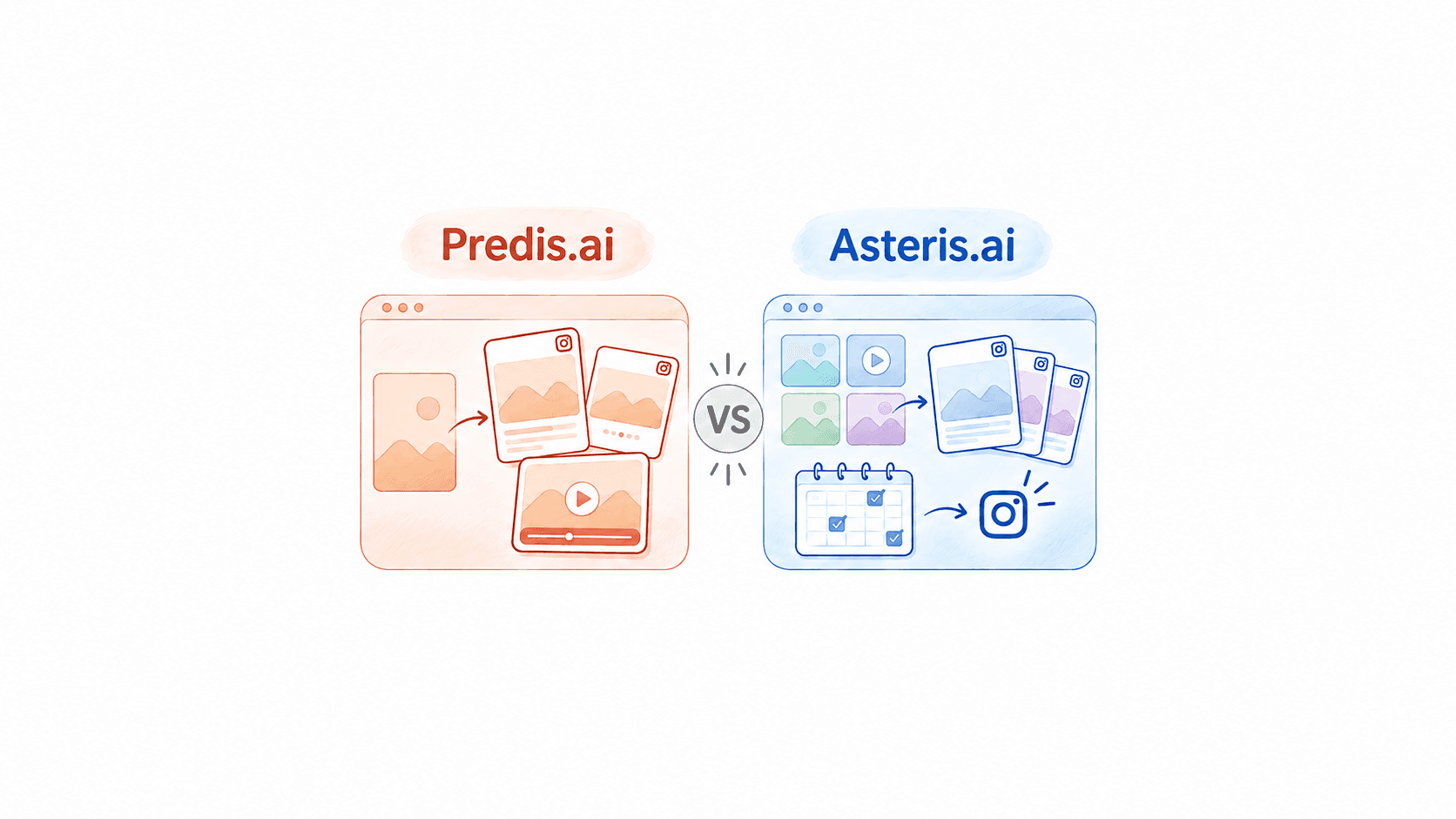
Predis.ai offers AI-generated Instagram posts, videos, advertisements and multi-platform publishing, with brand kits to maintain visual consistency. Asteris.ai builds Instagram posts and videos from a business's original photographs and clips. Both support branding and scheduling, but Asteris.ai puts greater emphasis on keeping visual content grounded in the actual business.
A restaurant can publish a beautifully designed photograph of a dish it has never served. A salon can advertise a hairstyle that nobody in the business has created, while an online shop can display a product in packaging that does not exist. These posts might use the correct logo and brand colours, but that raises a useful question when comparing AI Instagram tools: how much of your brand should the AI be allowed to invent?
Two approaches to Instagram
Predis.ai is a broad AI content creation and advertising platform. Businesses can generate Instagram posts, carousels, Reels and promotional videos from prompts, uploaded images and product information. Its tools also cover advertising creative, AI voiceovers, video generation and scheduling across several social networks. For a business producing regular campaigns across multiple channels, that breadth is a genuine advantage.1
Asteris.ai is built around a more focused Instagram workflow. Businesses upload their photographs and video clips, and the platform analyses the media to help generate relevant captions, post ideas and videos using the business's brand context. Drafts can be reviewed, refined and arranged in a recurring content planner before publication. The workflow is designed to make better use of material the business already produces.2
Both platforms can work with original photographs, generate branded posts and help schedule Instagram content. Predis.ai offers more ways to create entirely new promotional material, including AI-generated visual scenes. Asteris.ai concentrates on enhancing and repurposing the business's own media rather than generating fictional photographs from a prompt. That difference affects more than the appearance of the finished post.
Consider how small businesses normally collect their marketing material. A café photographs its new dishes, a hairdresser captures finished styles, a boutique records outfits and a product brand commissions photographs for its catalogue. The images already exist, but the business owner may have little time to decide what to post. The useful question is whether the software should create additional visual concepts or help organise and publish those existing moments.
The answer changes depending on the job. An advertising campaign may benefit from an imaginative, generated visual that could never be photographed economically. A salon portfolio or product demonstration, however, usually needs to show the service or item customers will actually receive. Both kinds of content have a place on Instagram, but they should not be evaluated as though they serve the same purpose.
Your brand is more than its colours
Predis.ai and Asteris.ai both support brand consistency, but the phrase covers several different things. Predis.ai provides brand kits containing logos, colours, fonts and tone of voice, helping generated designs retain a recognisable identity. Asteris.ai uses context from the business website alongside its uploaded photographs and videos to prepare content in the brand's voice. Both approaches help keep posts visually and verbally consistent.12
Brand styling, however, is only one part of a customer's impression of a business. A post can carry the correct logo, use exactly the right shade of blue and follow the approved typography while showing something the business has never produced. The design may look consistent with the brand guidelines, but the image itself may not accurately represent the products, services or surroundings. That distinction becomes especially important when Instagram acts as a shop window or portfolio.
Imagine a restaurant using AI to generate a photograph of a beautifully plated pasta dish. The result could include the restaurant's colours, branding and an appropriate promotional caption, yet the dish might never have appeared on its menu. A photograph of an actual dish prepared by the restaurant provides different information. It shows customers something they can reasonably expect to encounter when visiting or ordering.
The same distinction applies to beauty businesses, fashion retailers and ecommerce brands. A generated hairstyle cannot demonstrate a particular stylist's work, and an invented garment may show colours, textures or details that the actual product does not have. An AI-generated product scene can be useful for conceptual advertising, but it needs checking for anything that might mislead a buyer. Brand authenticity depends partly on whether the content represents the actual business, not only whether the design looks appropriate.
Predis.ai does allow businesses to upload original photographs, so using the platform does not require fictional imagery. Its generative capabilities provide additional creative freedom, including the ability to invent settings, scenes and advertising concepts. That flexibility can be valuable for some campaigns, but it also gives marketers another decision to make: whether the generated visual is suitable for the claim being made. Asteris.ai reduces that particular risk by making real business media the foundation of its image and video workflow.
This does not mean every post created with Asteris.ai will automatically be accurate or visually consistent. Original photographs can vary in quality, and editing, cropping, captions or outdated product information can still create misleading impressions. Both platforms require the business to review what will be published. The meaningful difference is that Asteris.ai begins with visual evidence of the business, while Predis.ai gives users the choice of working with that evidence or generating something new.
For a small business, that distinction deserves as much attention as templates, hashtags or image-generation quality. The strongest visual branding often comes from recurring recognisable details: the same interior, the products customers know, the people who deliver the service and the way the business photographs its work. Consistent design can reinforce those signals, but cannot create a truthful record of work that never happened. A brand kit and an original-media workflow therefore solve related but different problems.
Comparing the Instagram workflow
A feature list can make competing products look more similar than they actually are. Both Predis.ai and Asteris.ai offer AI-assisted creation, captions, branded content and scheduling, but their workflows prioritise different activities. Predis.ai provides a broad range of creative and advertising options, while Asteris.ai focuses on connecting existing media to recurring Instagram posts. The table below separates visual consistency from authenticity instead of treating them as the same feature.
| Instagram task | Predis.ai | Asteris.ai | Practical difference |
|---|---|---|---|
| Primary purpose | AI content generation, advertising and multi-platform publishing | Instagram content creation and planning from original business media | Broad creative platform versus specialised Instagram workflow |
| Starting point | Prompt, uploaded image, product link or creative reference | Uploaded business photos, videos and website-informed brand context | Predis.ai offers more input methods |
| Brand styling | Brand kits for logos, colours, fonts and tone | Website-informed brand context used in captions and posts | Both support consistent styling and messaging |
| Authenticity of visuals | Can use original uploads or fully AI-generated visuals | Builds visual content from the business's uploaded photos and clips | Asteris.ai has a stronger original-media foundation by design |
| Creative freedom | Can generate new scenes, images, avatars and advertising concepts | Concentrates on enhancing and repurposing existing business media | Predis.ai offers greater generative flexibility |
| Existing photo library | Uploads and uses photographs in creative generation | Analyses media and matches images with suggested posts | Asteris.ai makes media understanding central |
| Instagram graphics | AI-generated designs, editable templates and promotional creatives | Media-informed drafts, templates and editing tools | Different creative workflows |
| Reels and video | AI-generated video, product ads and voiceovers | Videos assembled and edited from uploaded photos and clips | Predis.ai for generative video; Asteris.ai for original-media repurposing |
| Captions and hashtags | Generated from prompts, images and creative context | Generated from selected media and business context | Both |
| Content planning | AI content calendar, bulk generation and scheduling | AI Planner with recurring Instagram drafts | Different planning approaches |
| Publishing | Scheduled and automated posting on eligible plans | Scheduling and publishing directly to Instagram | Predis.ai supports more social channels |
| Advertising campaigns | Dedicated AI advertising tools and creative variations | Primarily organic Instagram content | Predis.ai |
| Ecommerce marketing | Product-link generation and advertising creatives | Posts based on uploaded product and campaign photography | Predis.ai for catalogue-linked generation |
| Best suited to | Businesses needing varied creative, advertising and multi-platform content | Businesses seeking a repeatable Instagram workflow grounded in real media | Depends on the business's workload and priorities |
This comparison reflects publicly documented features, not an independent benchmark of content quality. Predis.ai can produce authentic posts using original photographs, and Asteris.ai can create new layouts and video treatments from existing material. It would be inaccurate to suggest that every Predis.ai post is synthetic or that every Asteris.ai post is automatically better. The products differ in what they make possible and what their workflows encourage.
The distinction also affects the effort involved in creating content. Generative flexibility can reduce the need for new photography when a business wants a conceptual campaign or a visual treatment it has not captured. A media-led workflow can reduce the need to choose and brief content repeatedly when good photographs already exist. The more useful solution depends on where the owner's time is currently being spent.
Four businesses, different needs
A restaurant, salon, fashion boutique and ecommerce brand could all aim to prepare four Instagram posts for the following week. Each has a different set of customers and visual material, but the underlying work is similar. Someone must select appropriate content, decide what each post communicates, write accurate captions and arrange publication. The distinction between generated visuals and actual business media becomes relevant in different ways for each industry.
Restaurants and cafés
A restaurant may want promotional content for a weekend menu, seasonal event or new opening. Predis.ai can generate branded advertising graphics and video concepts from a written brief, which could be useful when producing campaign variations. The owner can also upload original photographs to incorporate into the design. The platform offers options for creating visuals that go beyond what the kitchen has already photographed.
Asteris.ai would begin with photographs of actual dishes, drinks, preparation and service moments. Its workflow can help turn that material into a series of Instagram drafts, organised around the restaurant's posting schedule. The resulting content remains visually connected to what the restaurant serves and how it looks. That is particularly useful when customers use Instagram to decide whether a venue is worth visiting.
The relevant choice depends on the purpose of the post. A stylised illustration for a special event can be appropriate if it is clearly promotional artwork. A photograph presented as the restaurant's signature dish should accurately show the dish customers can order. Using the correct brand colours does not make an invented menu item real.
Hair and beauty businesses
For a hair salon, nail studio or beauty business, photographs often serve as a portfolio of completed work. A before-and-after image can demonstrate the result of an appointment, while a short clip can show the process or technique. These posts help potential clients judge whether a service suits them. Any identifiable client imagery also needs appropriate permission for marketing use.
Predis.ai can use those original photographs in promotional designs and generate additional video or advertising creative. Asteris.ai focuses on turning approved client results, treatment clips and salon photographs into recurring Instagram drafts. Both can support a professional-looking feed, but the actual result matters more than a fictional representation of an ideal treatment. A brand-consistent generated hairstyle does not demonstrate what a particular stylist has achieved.
This distinction also affects captions. A beauty business should not claim that an image shows a particular treatment result unless the photograph actually documents that result. Helpful content can explain techniques, aftercare, maintenance and booking considerations without exaggerating outcomes. AI tools can assist with the wording, but the salon remains responsible for the accuracy of the post.
Fashion boutiques
A fashion boutique may have product photography, lookbook images, styling clips and photographs of new arrivals. Predis.ai could use those assets to create sale announcements, advertising variations and promotional videos. It could also generate new visual concepts for a campaign. That additional creative freedom may be useful when the brand wants material beyond its existing photographs.
Asteris.ai can help organise the boutique's own outfits, collections and styling footage into an ongoing Instagram plan. Its approach keeps the posts connected to the clothing, accessories and styling combinations the business has photographed. That can be valuable when shoppers want to understand fit, fabric, colour and how an item looks when worn. A convincing generated outfit may be attractive, but it should not misrepresent a garment customers will purchase.
The same principle applies to a boutique's visual identity. Consistent photography, model styling, shop interiors and product presentation can make a feed recognisable without placing a logo on every image. Those details are part of what makes one boutique different from another. A media-led workflow preserves more opportunities to use them repeatedly.
Ecommerce product brands
Ecommerce brands often have extensive product libraries but limited time to create social content from them. Predis.ai can use product links and supported store workflows to create promotional assets, including advertising videos and product creatives. This is useful for catalogue-heavy businesses managing several products or frequent campaigns. The platform's wider advertising capabilities can be an advantage when Instagram is one of several marketing channels.
Asteris.ai works with uploaded product photographs, lifestyle images and campaign clips to develop regular Instagram content. A clean product image might support an announcement, while a demonstration clip or lifestyle photograph could explain how the item is used. The platform helps organise those assets into a recurring posting routine. This is particularly relevant to smaller brands with a carefully curated collection and a growing media library.
Accuracy matters in both workflows. A generated product image may introduce packaging, colours or features that differ from the actual item, while an original photograph can still become misleading through heavy editing or an incorrect caption. The brand should check product claims and visuals before publication. For more on using existing product media, see Your Product Photos Are Already Half a Content Calendar.
Questions before subscribing
Can Predis.ai use real photographs?
Yes. Predis.ai allows businesses to upload their own images and incorporate them into Instagram posts, carousels, videos and advertising creatives. It also offers generated imagery, so users can choose between existing assets and new visual concepts. Using Predis.ai does not automatically mean that a business's Instagram content will be synthetic.13
Which tool keeps content authentic?
Asteris.ai has a more deliberate original-media foundation because it builds image and video posts from photographs and clips supplied by the business. Predis.ai can also create authentic content from original uploads, but its fully generative features allow the creation of scenes that have not been photographed. Both can apply brand styling, and neither guarantees that captions or edited visuals will be accurate without review. The important difference is which kind of content each workflow starts with.12
Can both create Instagram Reels?
Both platforms support video content for Instagram, but the creation methods differ. Predis.ai offers AI video generation, voiceovers and advertising tools alongside uploaded-media editing. Asteris.ai turns existing photos and clips into social videos using editing techniques such as cropping, panning, zooming and sequencing. Businesses should test the specific Reel formats and publishing steps they need before choosing a plan.12
Which is better for Instagram advertising?
Predis.ai offers the broader set of dedicated advertising features, including AI-generated image and video ads, creative variations and product-based generation. Asteris.ai primarily concentrates on regular Instagram posts created from original business media. Businesses running frequent paid advertising campaigns have a stronger reason to investigate Predis.ai's additional capabilities. Those advertising creatives still need to represent products and services accurately.1
Can both schedule Instagram posts?
Yes. Both platforms provide content planning and publishing workflows, although Predis.ai supports several social networks while Asteris.ai specialises in Instagram. Predis.ai's automatic posting depends on the subscription plan, whereas Asteris.ai includes Instagram scheduling in its workflow. Businesses should verify current account and format requirements for their particular publishing needs.24
How do their prices compare?
On 11 November 2026, Predis.ai advertised Core at $19 per month and Rise at $40 per month with annual billing, with automatic posting included in Rise but not Core. Asteris.ai advertised a free plan and paid tiers at £10, £16 and £20, with increasing monthly AI quotas. The prices use different currencies and the products have different generation allowances and feature sets. Businesses should compare the cost of their intended posts and videos rather than simply choosing the lowest advertised subscription.56
Try the same four posts
A practical comparison should use the business's actual media rather than an impressive demonstration built from generic examples. Choose twelve photographs and three short clips, then prepare the same four Instagram posts in both platforms. Include a product or service announcement, an informational post, a short video and a post that gives customers a useful reason to enquire or buy. Provide the same brand information and check every output against the business's real products and services.
Test two approaches within Predis.ai where the available features allow it: one using only your original photographs and another using AI-generated visual concepts. Compare these with the original-media workflow in Asteris.ai, including how the images are selected and arranged in the weekly plan. Look at whether each result accurately represents the business, how much editing is needed and whether the posts feel visually repetitive. This helps reveal the difference between creative flexibility and a workflow designed around genuine business media.
Record how much time is spent preparing prompts, selecting photographs, correcting captions, editing videos and scheduling the posts. Repeat the exercise the following week with a different set of assets, because a one-off result does not reveal how easy the process will be to maintain. Buffer's analysis of 2.1 million Instagram posts suggests that publishing three to five feed posts weekly can be a reasonable balance between reach and effort, although the results vary by account.7 The content still needs to be worth publishing, regardless of the chosen frequency.
Predis.ai is a strong option for businesses that want extensive AI-generated creative, advertising tools and publishing across several channels. Asteris.ai offers a more focused approach for businesses that already produce useful photographs and videos and want to turn them into regular Instagram posts. Both can help reduce content preparation work, but they give different weight to creative generation and the business's actual media. The better tool depends on which of those needs is most important.
Brand consistency deserves a final distinction. Keeping the same logo, colours and tone can make posts look recognisable, but it cannot establish that the products, services or scenes shown actually belong to the business. An AI-generated image may be perfect for a conceptual advertisement, while an authentic photograph may be better suited to showing a real result or product. Choosing an Instagram tool should include deciding which of those jobs the business needs to perform most often.
For businesses that want to start with their own media, Asteris.ai's Instagram content platform connects uploaded photographs and clips with content creation, planning and publishing. Predis.ai offers greater creative freedom when the business needs generated advertising assets and broader distribution. The distinction matters because the value of a good Instagram post comes from what it communicates about the business, not simply how closely it follows a brand colour palette.
About this comparison
This comparison is published by Asteris.ai, one of the products discussed. Product capabilities and advertised pricing were reviewed against publicly available documentation on 11 November 2026. The business examples are illustrative, and no controlled hands-on comparison of content quality, preparation time, engagement or sales outcomes has been conducted. Features, prices and publishing requirements may change after publication.
Sources
Footnotes
Instagram post generation, design editing and templates, Predis.ai Instagram Post Maker↩
Scheduling and automated publishing workflows, Predis.ai Auto Post↩
Predis.ai subscription pricing, generation credits and automatic posting, Predis.ai Pricing↩
Asteris.ai's free and paid Instagram content plans, Asteris.ai↩