
Plan a Month of Instagram Posts in One Afternoon, Without a Filming Day
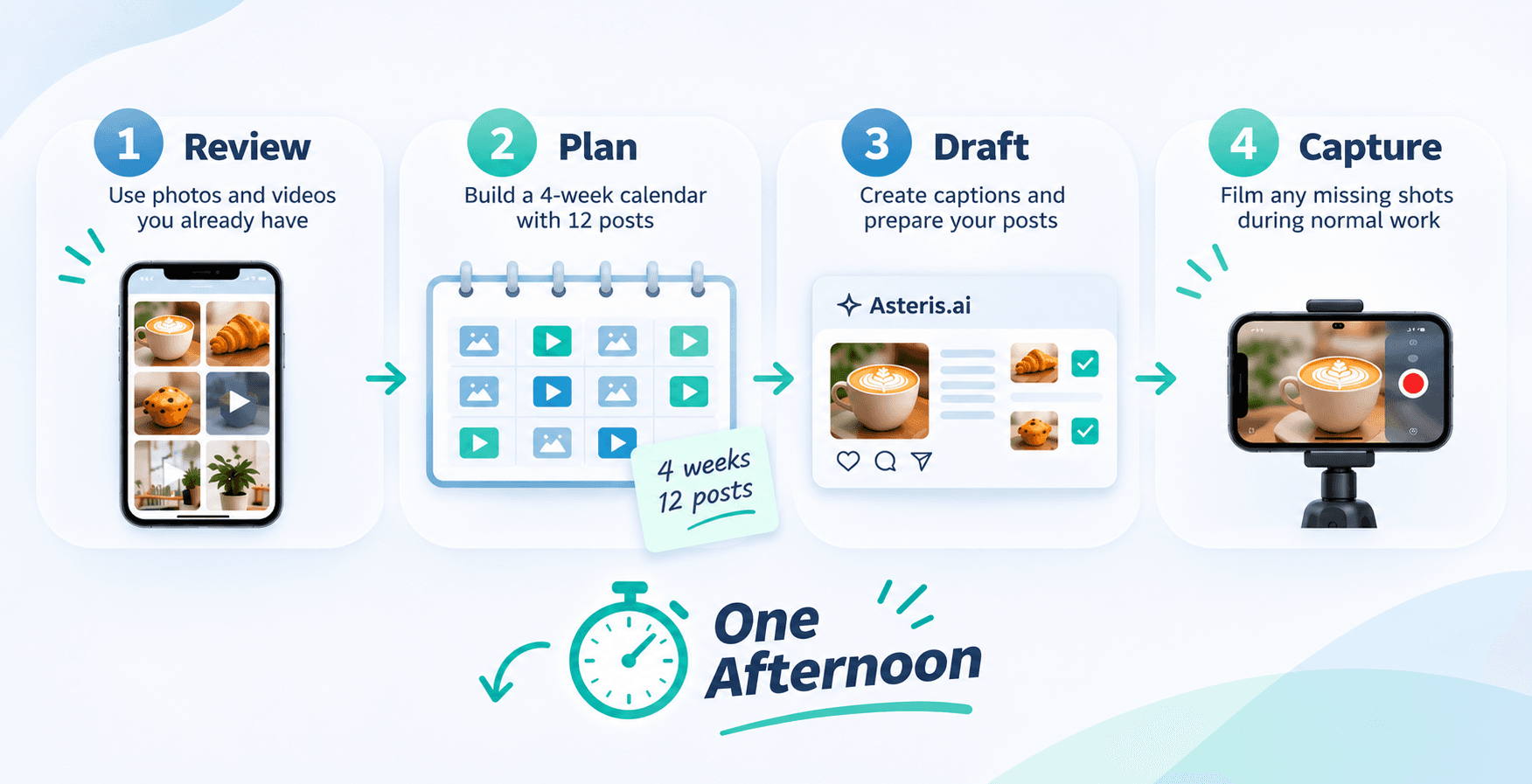
To plan a month of Instagram posts in one afternoon, pick one business goal, sort the photos and videos you already have, fill 12 slots across four weeks with a purpose, format and caption, schedule whatever is ready, and write a shot list for the rest to capture at work.
Most guides to batching Instagram content describe a full production day, with scripting in the morning and filming over lunch. That works for a creator whose job is the content. It falls apart for a café owner, a stylist or someone packing Etsy orders, because the moments worth posting happen while the business is open. This is a plan for the afternoon you can actually spare.
Plan the month, film it later
Sprout Social's guide to batching 30 days of Instagram content runs from 9am brainstorming to 4.30pm scheduling, with two and a half hours of filming and sourcing in the middle.1 That suits a marketer with a tripod and a quiet corner. For a restaurant, the best footage is the pass at 7.30pm on a Friday, which nobody can stage on a slow Tuesday. A salon's strongest material is a client's face in the mirror, and that only exists while someone is in the chair.
So split the work in two. The afternoon covers every decision that does not need the doors open: what goes out each week, in which format, with which caption, and which shots are still missing. The filming happens across the month, in the few seconds it takes to grab a clip while the work is happening anyway. A request as specific as four photos of the lunch special being plated on Thursday is also far easier for whoever is on shift to say yes to than a general plea for help with Instagram.
Pick one goal for the month
Before opening the camera roll, decide what Instagram needs to do for the business over the next four weeks. A café might want more weekday lunch trade, a salon might need to fill an underbooked colour service, and an online shop might be launching a winter collection. One goal is enough, because its real job is to settle choices later in the afternoon: when two clips compete for the same slot, the one that serves the goal wins.
The goal also changes what you show. Latte art helps people recognise a café, but it gives nobody a reason to come in at lunchtime; the lunch menu, the portion sizes and a sandwich being built in front of them do. Spend ten minutes in your Insights first, looking at which recent posts led to profile visits, messages or bookings, and ignore which ones simply collected views. A salon may find that transformation Reels bring enquiries while quote graphics bring nothing, which is worth knowing before planning another month of quotes.
How many posts is enough?
Buffer analysed 2.1 million posts from 102,000 accounts and compared each account with its own baseline, which makes it more useful than studies that set big accounts against small ones.2 Moving from one or two feed posts a week to three to five more than doubled the follower growth rate and lifted reach per post by around 12%. Posting more often kept helping, but each extra step added less. Weeks with no posts at all came in below an account's normal growth, which Buffer's data scientist calls the no-post penalty.2
For most small businesses, that points to 12 posts a month, three a week, with a fourth when there is good material. That is fewer than the 20 or so a month that brand accounts averaged in Socialinsider's 2025 data, and it is enough, because the number that hurts is zero.3 Put the posts on fixed days such as Monday, Wednesday and Friday, which spreads them out the way Instagram's creator guidance suggests and tells everyone when the next one needs to be ready.4
Your camera roll comes first
The next 45 minutes go on the camera roll. Scroll back through the last two months on every phone that has been near the business and favourite anything usable: a plate under good light, a before-and-after colour, a parcel being taped for dispatch, a regular laughing at the counter. Many owners have been taking these pictures for months without a plan for them. Move everything starred into one shared album so the rest of the afternoon works from a single pile.
Working from your own media is also what Instagram now rewards. In January 2026, Meta reported that 75% of Instagram recommendations in the US now come from original posts, after it raised their share by ten percentage points in the last quarter of 2025.5 Since April 2026, accounts that mostly repost other people's material have not been recommended to non-followers at all.4 Adam Mosseri's year-end memo pointed the same way, arguing that polished imagery has become cheap to make and dull to watch, while rougher footage now works as proof that something was not generated.6
A slightly blurry clip of a chef plating at full speed is often worth more than it looks. The job is to judge which moments carry the business and decide what each one needs: a tighter crop, a better first frame, a caption that says what is happening. Tools like Asteris.ai are built for this step, analysing a business's own photos and videos to find the frames and opening seconds with the strongest hook, then enhancing that footage instead of swapping it for generated stock. A person still approves what goes out, including checking there is permission for any customer or staff member who appears.
Give every slot a job
With the album ready, fill the calendar. Pick three content pillars, such as the work itself, the people behind it and proof from customers, since fewer pillars mean faster decisions.1 Then give every slot five things. Written out, a single slot looks like this:
Format is where the data helps most. In Buffer's analysis of more than four million posts, Reels reached 36% more people than carousels, while carousels earned 12% more engagement than Reels.4 Socialinsider's tracking agrees that carousels have held the top engagement rate in most quarters and drive the most saves, while engagement on single images fell about 17% year on year.3
For a 12-post month, five Reels, five carousels and two single photos is a sensible split. That leans harder on carousels than most brands do, which suits a small business: a carousel can be built from photos you already have plus a couple of text slides, while a Reel usually needs a clip with something happening in it. Mosseri has named watch time, likes per reach and sends per reach as the signals that matter most, with sends counting slightly more when Instagram decides whether to show a post to non-followers.4 So when you write each hook, ask whether anyone would forward it to a friend.
For an independent café whose goal is more weekday lunch trade, the month might look like the table below. Each slot notes whether the media already exists or still needs capturing, which is what turns the calendar into a shot list. The Monday, Wednesday and Friday slots are there because they are easy to remember, and your own Insights will suggest better days in time.
| Week | Monday | Wednesday | Friday |
|---|---|---|---|
| 1 | Reel: a flat white from grind to pour (have) | Carousel: the winter lunch menu, dish by dish (capture) | Photo: the weekend special with price and times (capture) |
| 2 | Reel: pastries going into the oven at 7am (capture) | Carousel: which coffee to order if you dislike bitterness (have, plus text slides) | Reel: the most-ordered lunch sandwich being built (capture) |
| 3 | Carousel: what is vegan, gluten-free or dairy-free this month (text slides) | Reel: the lunchtime rush in 15 seconds (capture) | Photo: a seasonal bake and a reason to visit this weekend (capture) |
| 4 | Reel: unlocking the door and the first customers in (capture) | Carousel: four questions people ask at the till, answered (text slides) | Carousel: customer photos from the month, shared with permission (have) |
Five of the twelve posts can be made today from the camera roll or simple text slides, and seven need something captured during the month. That ratio should shift towards the camera roll as the shared album fills over the following months. The same grid works elsewhere: a salon swaps the coffee Reel for a colour transformation and the menu carousel for a guide to treatment times, while an online shop uses Reels for products in use and carousels for sizing and materials.
The afternoon, block by block
The timings below assume one person working through it, with the phones already gathered on the table. They add up to three and a half hours, which fits between lunch service and the evening rush or into a closed Monday. Protect the time the way you would protect a supplier meeting, because a plan made in stolen ten-minute gaps tends to come out as three posts and a good intention.
Writing all twelve captions in one document is where most of the time is saved. You notice when three in a row end with "link in bio", or when the same dish turns up twice in a fortnight. Open each caption with the customer question the post answers, add the useful detail, and close with one action that serves the month's goal. Keep hashtags short, since Instagram now caps posts at five and has said they do not help reach.4
Scheduling costs nothing inside the app. Professional accounts can schedule photos, videos, carousels and Reels up to 75 days ahead and up to 25 posts a day, which covers a month comfortably.7 If you schedule through a third-party tool, posts that use music from Instagram's sound library or interactive features may still need finishing in the app on the day.1 Anything waiting on a clip stays on the calendar as a named gap with a date next to it, and those gaps become the shot list that goes on the wall by the till or into the staff group chat before you close the laptop.
Leave room around the plan as well. Sprout's guide warns against filling every slot so there is space for timely updates, and a small business always has something coming: a sold-out bake, a new stylist starting, a delivery that turned up late.1 A quick Story or an extra post covers those without breaking the month. Spend fifteen minutes each Monday checking that the week's scheduled posts still match reality, from prices and stock to opening times and any offer that might have ended. A scheduled post promoting a sold-out special does more damage than a missed slot.
Judge the month by the goal
Month-long plans usually collapse at the production stage. They assume someone will find a spare day to film, and in a small business that day rarely arrives. Moving the decisions into one afternoon and the filming into normal working hours makes the plan fit the business. It also keeps the content honest, because every post comes from something that actually happened.
At the end of the month, measure the posts against the goal you set at the start. If the goal was lunch trade, look at profile visits, messages, menu link clicks and anything you can trace at the till, and treat views as background. Within Instagram, sends and saves per post say more than raw counts, which is the comparison Mosseri has pushed creators to make.4 The posts that moved the goal go into next month as patterns, the same kind of moment filmed fresh, and the second planning afternoon will be quicker because the pillars and caption document already exist.
None of this needs AI to work, and none of it should hand the decisions to software. Where tools earn their place is in the slow, fiddly middle: finding the best three seconds in a long clip, fixing a crop, suggesting a caption in the business's own voice for someone to approve or rewrite. The owner still decides what the business says about itself. That split is what lets a feed stay consistent and still sound like the people who run it.
Sources
Footnotes
Sprout Social's one-day workflow for batching 30 days of Instagram content, Sprout Social↩↩2↩3↩4
Instagram organic engagement benchmarks by format, saves and posting frequency, Socialinsider↩↩2
Report on Adam Mosseri's December 2025 year-end memo on authenticity and AI imagery, Technobezz↩
How to schedule posts and Reels natively in the Instagram app, Search Engine Journal↩