
Later vs Asteris.ai: The Instagram Grid Is Only Half the Job
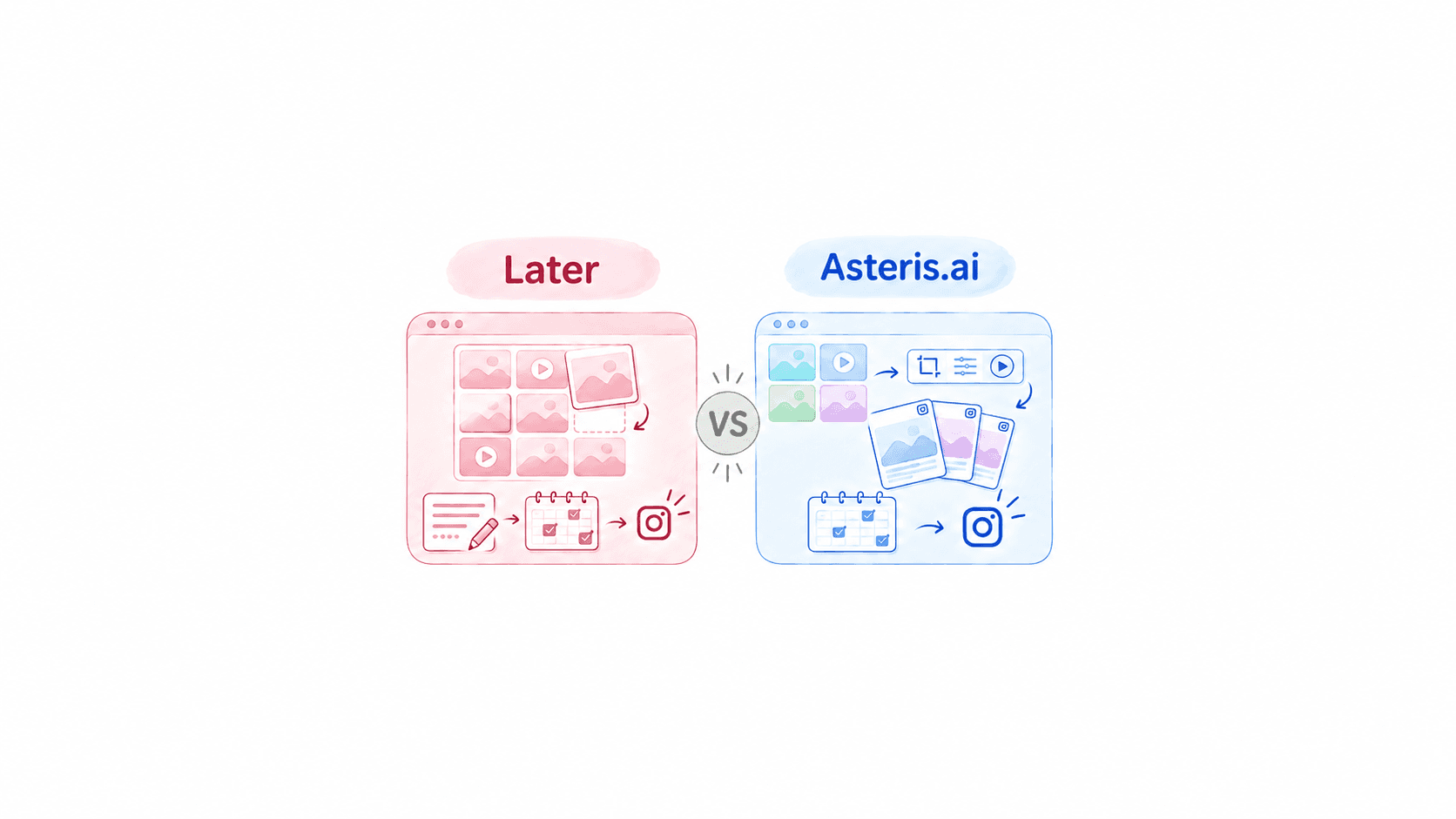
Later helps businesses organise their Instagram feed, preview how posts will look together, write captions with AI and schedule content. Asteris.ai starts earlier, using AI to analyse a business's own photos and videos, turn them into finished Instagram posts and maintain a recurring content plan. Both support Instagram publishing, but they are built around different parts of the work.
A beautifully arranged Instagram grid can make a business look organised and recognisable, but the grid still needs photographs, videos and captions worth publishing. For a café, salon, boutique or product brand, that content often begins as ordinary photographs taken during the working week. Choosing between Later and Asteris.ai means deciding whether the greater challenge is organising finished posts or getting from raw media to something ready for the calendar.
Later knows what your Instagram feed will look like
Later's Visual Instagram Planner is one of its most recognisable features. Businesses can preview how scheduled photographs, videos, drafts and published posts will appear together, then drag upcoming content into a different order before publication. That gives owners and social media managers a way to consider the overall look of the feed rather than planning each post in isolation. For brands that care about their visual identity, it is a genuinely useful feature.1
Imagine a fashion boutique preparing for a new collection. The owner wants a mix of full-length outfit photography, close-ups, styling videos and launch announcements, but does not want the feed dominated by nearly identical product shots. Later makes it easier to see the planned sequence and rearrange the upcoming posts until the mix feels balanced. It also supports a broader visual calendar for managing content across other social networks.
Later has developed well beyond an Instagram grid planner. Its platform includes scheduling, analytics, content ideas, AI-assisted caption writing, Best Time to Post recommendations, Link in Bio and tools for social media teams. Higher plans add features such as approval workflows, social inbox capabilities and more advanced analysis. For a brand managing several channels or working with an agency, those capabilities provide value beyond making the feed look attractive.2
Its Link in Bio feature is particularly relevant for businesses using Instagram to encourage enquiries, bookings or purchases. A boutique can direct people towards collections, while a salon can feature its booking page or current services. Later also supports Instagram Shop product tagging on eligible Growth and Scale plans, provided the connected account and catalogue meet the relevant requirements. This gives Later an advantage for businesses that want more tools around the published post and its subsequent performance.3
The important distinction is what happens before the owner can arrange those posts. A grid preview can show whether a sequence looks balanced, but it does not necessarily turn a collection of unfinished photographs into suitable designs and videos. Someone still needs to decide what the raw media should communicate, prepare the visual content and check that each post represents the business accurately.
Later has AI, but what does it prepare?
Later also offers meaningful AI capabilities, so describing it as a traditional scheduler without AI would be inaccurate. Its AI Caption Writer can generate copy from a short description and tone instructions, while the Ideas feature helps businesses develop topics and content pillars. Later also uses account activity and other signals to support posting-time recommendations and trend-based planning. These tools are integrated into its social media workflow rather than existing as disconnected applications.4
For a business that already knows what it wants to publish, that assistance can be useful. A restaurant owner might have a finished photograph of a weekend special and use Caption Writer to draft supporting copy. A beauty business could start with a completed treatment photograph and ask for several caption variations, then edit the chosen version to reflect the service performed. The AI helps with the writing and planning decisions surrounding the post.
Later's visual tools also cover some editing work. Its current feature documentation includes video cropping and trimming, adding text to images on paid plans, and editing features associated with scheduled content. It would therefore be misleading to suggest that Later cannot make any adjustments to visual material. The distinction is that Later's documented AI creation tools focus primarily on ideas and captions, rather than a dedicated workflow for analysing an entire business media library and constructing posts from it.5
Later's AI can also help maintain a recognisable writing style. Its Caption Writer supports tone changes and the company describes using previous brand content to inform generated captions. This means brand voice is not an exclusive Asteris.ai feature. The difference is how the platform connects that voice to the actual visual content being used in the post.
A business should therefore consider how much content preparation remains before opening Later. If its team already produces polished designs, edited videos and approved images, Later can be an excellent place to arrange and distribute them. If the owner regularly has photographs but no completed Instagram posts, another part of the workflow may need more attention.
Asteris.ai works before the grid
Asteris.ai begins with the business's own photographs and video clips rather than expecting finished social media designs. The platform analyses uploaded media, identifies what it shows and uses brand context drawn partly from the business website to help generate relevant post ideas and captions. It can match suitable images to proposed posts, prepare video content from existing footage and organise the resulting drafts for review.6
That difference becomes significant when a business creates visual material as part of its ordinary work. A salon takes photographs of completed hairstyles, a restaurant captures dishes as they leave the kitchen, and a boutique records new outfits or deliveries. These files contain valuable information about the business but are rarely organised into finished Instagram posts when they are first captured. Asteris.ai is built to help bridge that gap.
The content preparation process also includes visual refinement. Uploaded photographs and clips can be used to create image posts and social videos, with editing options for layouts, cropping, sequencing, text and branding. The business can inspect the proposed drafts and make adjustments before approving them. The purpose is to reduce the repeated effort involved in selecting, assembling and polishing social content.
Asteris.ai's planner connects that preparation work to a posting cadence. Rather than simply displaying the posts a business has already created, the platform helps populate the calendar with AI-prepared drafts based on available media. Owners can review the proposals, refine the results and schedule approved content for Instagram. The planning function is therefore closely connected to the content-generation process.
This does not make the calendar irrelevant. Asteris.ai still needs to help the owner see what is planned and when posts will appear, just as Later does. The difference is that AI is designed to contribute more directly to producing the content that fills those calendar slots. A business choosing between the two should decide whether its main difficulty is arranging posts or preparing them in the first place.
Compare the work, not just the features
Later and Asteris.ai overlap in several areas, including AI-assisted writing, post planning, brand consistency and Instagram publishing. Later's strengths are particularly visible in feed previews, multi-channel workflows and performance tools. Asteris.ai puts greater emphasis on analysing and repurposing original business media to prepare publishable content. Those different priorities become easier to evaluate when viewed as ordinary Instagram tasks.
| Instagram task | Later | Asteris.ai | Practical difference |
|---|---|---|---|
| Primary purpose | Social media planning, visual scheduling, analytics and publishing | AI-native Instagram content creation, planning and publishing | Planning-first versus media-preparation-first |
| Starting point | Content ideas, uploaded media, drafts or prepared posts | Original business photographs, clips and brand context | Different starting stages |
| AI content ideas | Ideas feature generates topics and content pillars | AI suggests posts informed by uploaded media and business context | Both support ideation using different inputs |
| AI captions | Caption Writer generates and revises copy using prompts and tone | Creates captions using selected media and brand context | Both support AI writing |
| Understanding uploaded media | Media library and tools for organising and preparing posts | Analyses and annotates uploaded media to inform draft generation | Asteris.ai makes media analysis central |
| Image preparation | Media editing and text overlays, with features varying by plan | AI-assisted post preparation, editing and templates | Asteris.ai places greater emphasis on turning raw images into finished posts |
| Video content | Video cropping and trimming, Reel scheduling and related publishing tools | Builds and edits social videos from original photographs and clips | Different levels of video preparation |
| Instagram grid preview | Dedicated Visual Instagram Planner with drag-and-drop reordering | Content calendar and post previews | Later has a stronger dedicated feed-layout feature |
| Weekly planning | Visual calendar, scheduling and AI-supported ideas | AI Planner prepares recurring Instagram drafts for review | Scheduling planned content versus also generating drafts |
| Visual brand identity | Helps maintain a consistent appearance through feed planning and supplied assets | Uses original business media as the foundation of content | Different approaches to visual consistency |
| Brand voice | Caption Writer supports tone and brand-aware copy | Website-informed business context supports captions and drafts | Both address brand voice |
| Best Time to Post | Posting-time recommendations informed by account data | Scheduling and timing adjustments | Later has stronger documented timing optimisation |
| Instagram publishing | Auto-publishing and format-specific scheduling | Instagram scheduling and auto-publishing | Both |
| Link in Bio | Dedicated tool with linked posts and landing-page features | Not a comparable dedicated feature in the core Instagram workflow | Later |
| Instagram analytics | Performance reporting and account insights on eligible plans | Primarily content preparation and publishing | Later |
| Multiple social platforms | Instagram, TikTok, Facebook, LinkedIn and others | Primarily Instagram | Later |
| Team collaboration | Approval, sharing and team features on eligible plans | Review and approval within the content workflow | Later offers broader team management |
| Best suited to | Brands with content to organise, publish and measure | Businesses turning a raw media library into regular Instagram posts | Depends on where the work begins |
The table describes published capabilities, not the outcome of a controlled product test. Later can work with original photographs, create captions and make certain visual edits, while Asteris.ai includes planning and publishing tools alongside content generation. Neither product is restricted to one step of the workflow. The distinction is where each product concentrates its functionality and the work it is designed to reduce.
For an agency with several clients and a dedicated creative team, Later's grid preview, analytics and approvals may be especially valuable. For an independent owner whose camera roll contains plenty of useful material but whose Instagram calendar remains empty, Asteris.ai's earlier-stage content preparation may be more relevant. A business could reasonably choose either platform depending on its people, existing tools and marketing priorities.
A consistent feed is not always an authentic one
A visually consistent Instagram feed can make a brand recognisable, but consistency is not only about colour palettes and grid arrangements. A restaurant has its own food and atmosphere, a salon has the results of its stylists' work, and a fashion boutique has specific products and styling choices. Those details are part of the visual identity customers associate with the business. A feed that repeatedly shows genuine moments can be more distinctive than one relying entirely on polished but interchangeable promotional designs.
Later gives businesses tools to manage that overall appearance. Its Visual Instagram Planner helps owners arrange upcoming posts so the feed feels cohesive, and its AI writing features can assist with consistent messaging. A business that supplies high-quality original photography can use Later to maintain a recognisable and authentic Instagram presence. The platform is not dependent on generic or synthetic imagery.
Asteris.ai approaches consistency from another direction by making original business media the starting point for post generation. The photographs and clips used in the content come from the business, while AI helps improve how they are selected, presented and explained. This can help preserve recognisable products, interiors, services and visual details across the feed. It is particularly valuable when the Instagram account serves as evidence of what a business actually makes, sells or does.
A consistently styled post can still misrepresent a business if its visual details or claims are inaccurate. Similarly, an original photograph can become misleading through excessive editing or an incorrect caption. Both platforms require owners to review content before publication, especially when it includes client photographs, product information or time-sensitive offers. The advantage of an original-media-led workflow is that it starts with something real, not that every resulting post is automatically accurate.
For a practical explanation of that distinction, see Your Instagram Posts Need More Than a Brand Voice Prompt. The article examines why a recognisable brand voice should be supported by genuine photographs, consistent editorial choices and human review. Those factors matter whichever platform a business chooses for planning and publishing.
Four posts, one ordinary week
Imagine a small business preparing four Instagram posts from twelve photographs and three short clips. The material includes examples of recent work, products, everyday activity and a few images that would need cropping before publication. The owner wants a balanced week rather than several posts with nearly identical photographs or captions. This is a useful assignment because it involves both content preparation and visual planning.
Using Later, the owner could develop ideas, attach media, use Caption Writer and make basic adjustments before arranging posts in the Visual Instagram Planner. The grid preview would help identify awkward repetitions or an unbalanced sequence, while the calendar and Best Time to Post features could assist with scheduling. Once the visual content is ready, the process is well suited to organising and publishing it. A team could also use analytics afterwards to understand how the posts performed.
With Asteris.ai, the owner would upload the source media and use its AI-assisted workflow to develop the post ideas, visual drafts and captions. A short video could be assembled from suitable images and clips, while other photographs could become image posts prepared around the business's brand context. The owner would refine the drafts, remove unsuitable options and arrange approved posts in the planner. The main value to test would be how much preparation work the AI takes on before scheduling.
Neither approach removes the need for editorial judgement. The business still needs to decide whether a photograph is suitable, whether a caption is accurate and whether a particular message deserves a place in the week's content. The difference is which tasks the software handles before those decisions are made. The most revealing comparison is the effort required to reach four posts the owner would genuinely publish.
The prices reflect different jobs
Later's pricing reflects its broad social media management platform, with subscriptions organised around social sets, users, publishing limits and feature availability. On 17 November 2026, its pricing page advertised annual-billing rates of $18.75 per month for Starter, $37.50 for Growth and $82.50 for Scale under the displayed promotional offer. The plans included 5, 50 and 100 monthly AI credits respectively, with one credit used for one caption or three generated ideas. Later also advertises a 14-day trial, and its Help Centre documents a separate limited free plan.7
Some important Instagram features are restricted by tier. Later's Visual Instagram Planner is available on free and paid plans, but its current paid plans are required for Instagram carousels and Stories scheduling. Instagram Shop product tagging, more advanced analytics and certain collaboration capabilities require higher plans. Businesses should check the exact features they use rather than assuming that every part of Later's platform is included in the lowest-priced subscription.8
Asteris.ai uses an AI quota model because media analysis and content preparation are central to the product. Its published pricing offers a free starter plan, with Base at £10, Plus at £16 and Pro at £20, and higher tiers providing larger allowances for image and video creation. The AI Planner is included across the plans, while additional media and content-generation capacity increases with the subscription. Asteris.ai is more focused on one channel, so its pricing is not structured around multiple social networks.9
The headline figures are not directly comparable because they use different currencies, quotas and billing conditions. Later may provide excellent value to a business that wants analytics, a link-in-bio page, visual planning and cross-platform management. Asteris.ai may provide more value when the owner spends substantial time selecting photographs, assembling posts and preparing videos before scheduling. The relevant expense is the total work required to maintain the account, not simply the subscription shown on the pricing page.
Questions before choosing a tool
Is Later an AI Instagram content tool?
Yes. Later provides AI-generated content ideas and captions, along with scheduling and data-informed recommendations for publishing times. Its AI Caption Writer can generate and revise text using a short description and tone guidance, while the Ideas feature helps develop content themes. Its current AI offering primarily supports ideation, writing and planning rather than the raw-media-to-post workflow that Asteris.ai emphasises.4
Can Later automatically create Instagram posts from my photos?
Later supports photo uploads, scheduling, text overlays and some editing capabilities, and it can generate captions to accompany images. However, its documented AI tools do not provide the same dedicated media-analysis and automated post-preparation workflow described by Asteris.ai. Businesses looking for AI to select, interpret and turn a collection of original media into finished posts should test that distinction directly.
Does Asteris.ai offer an Instagram grid planner like Later?
Asteris.ai provides a content calendar, draft previews, scheduling and review controls, but Later has a more specialised Visual Instagram Planner for rearranging the appearance of upcoming posts in the profile grid. Asteris.ai focuses more on preparing the content that fills the calendar using original business media. The better choice depends on whether visual grid arrangement or AI-assisted content production is the more important requirement.
Which is better for Instagram Reels?
Later supports Reel scheduling and provides video cropping and trimming tools, making it useful when the business already has suitable video content. Asteris.ai places more emphasis on creating social videos from original photographs and clips before they are scheduled. A business that regularly produces finished Reels may prefer Later's wider management tools, while one working from unedited footage may benefit from Asteris.ai's media-led workflow.
Which is better for Instagram analytics and product links?
Later has the stronger documented offering for both. It provides Instagram analytics on eligible plans, Link in Bio landing pages and Instagram Shop product tagging on Growth and Scale, subject to account requirements. Asteris.ai's main proposition is creating, reviewing and publishing Instagram content from original media, rather than providing the same breadth of analytics and commerce-link features.38
The grid is only half the job
A useful trial should begin with the same collection of photographs and clips in both platforms. Prepare four posts, including one Reel, and record how much time is spent selecting media, editing visuals, writing captions, refining drafts and arranging the publication schedule. Then repeat the process with a different set of images the following week. That second session helps reveal whether the chosen tool makes content preparation easier to repeat.
Later is a strong choice for businesses that want to organise an Instagram feed visually, schedule across several platforms, manage links and analyse performance. Its AI tools support ideation and caption writing, while its dedicated grid planner makes the appearance of the feed easier to manage. Asteris.ai is designed for businesses that need more help turning their existing photographs and videos into finished Instagram content before it reaches the calendar. The differences are practical rather than absolute, and each platform may suit a different stage of a business's marketing work.
For an independent business with good photography but little time to prepare posts, the greatest opportunity may be before the grid becomes visible. The photographs need selecting, the content needs polishing and the captions need to reflect what the business actually does. Asteris.ai's Instagram content platform focuses on that preparation work, then connects it to planning and publishing. A well-arranged Instagram feed matters, but the work that goes into every post matters just as much.
About this comparison
This comparison is published by Asteris.ai, one of the products discussed. Product capabilities and advertised prices were reviewed against publicly available documentation on 17 November 2026. The examples describe illustrative workflows rather than a controlled hands-on comparison, and no independent measurements of content quality, preparation time, reach or sales performance have been conducted. Product features, plan allowances, promotional prices and publishing requirements may change after publication.
Sources
Footnotes
Instagram grid preview, draft arrangement and drag-and-drop scheduling, Later Visual Instagram Planner. ↩
Social media planning, scheduling, analytics and AI-assisted workflow, Later Social Media Management. ↩
Link in Bio capabilities, Later Link in Bio, and Instagram product-tagging availability, Later Plan Features. ↩↩2
AI content ideas and writing, Later AI Tools and Caption Writer Help. ↩↩2
Image, video and Instagram publishing features by plan, Later Social Plan Availability. ↩
Media analysis, post preparation, AI Planner and Instagram publishing, Asteris.ai Platform. ↩
Later's Starter, Growth and Scale plan prices and AI credits, Later Pricing. ↩
Plan restrictions for Stories, carousels, analytics and Instagram Shop product tags, Later Help Centre. ↩↩2
Asteris.ai's free, Base, Plus and Pro AI quota plans, Asteris.ai. ↩