
Buffer vs Asteris.ai: Who Prepares the Instagram Post?
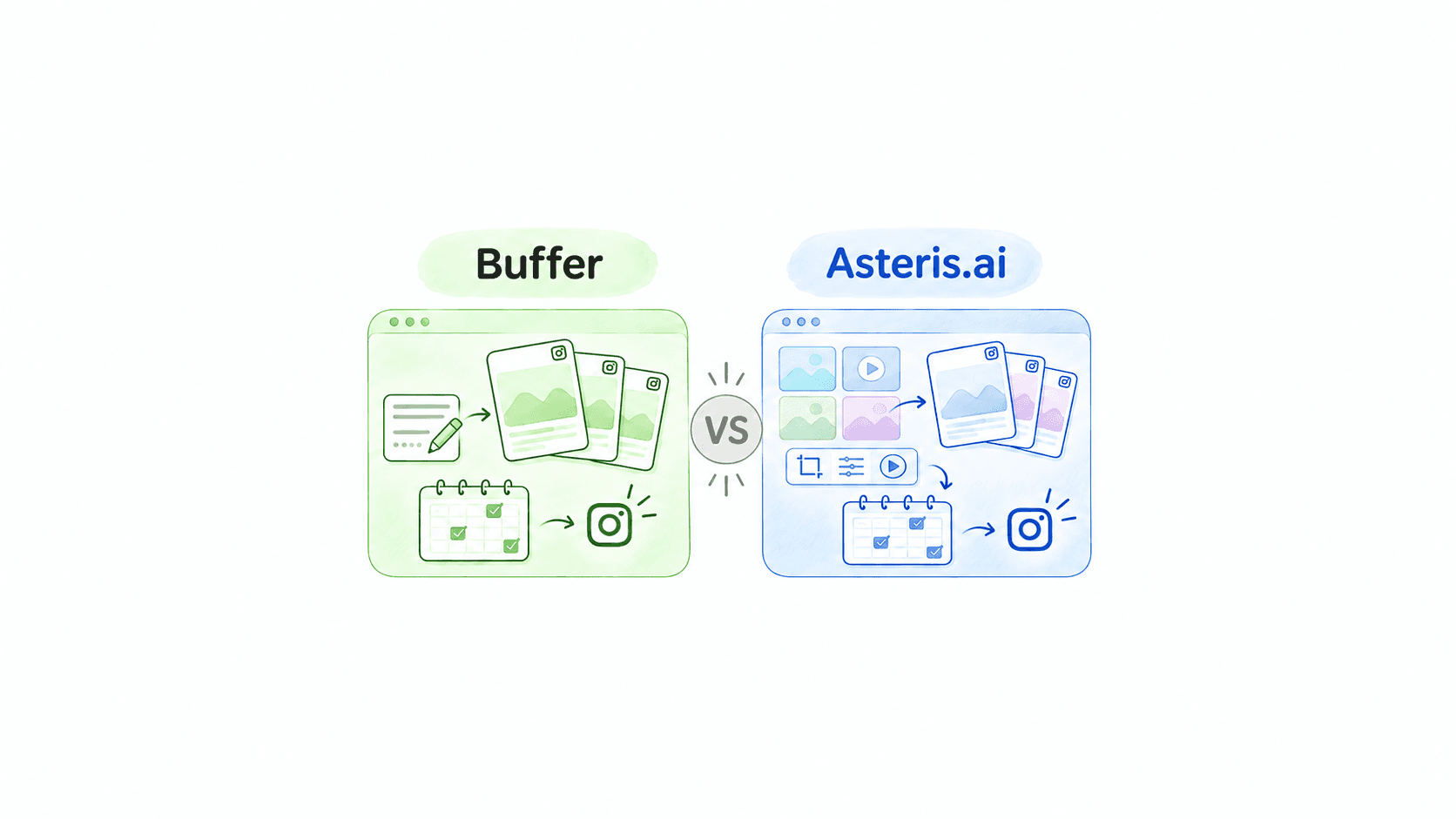
Buffer organises and publishes social posts, with AI writing assistance built in. Asteris.ai uses AI to turn a business's own photos and clips into Instagram-ready content before scheduling. The better fit depends on whether you need help distributing posts or preparing them.
A small business owner can have thirty excellent photographs on their phone and still have nothing ready for Instagram next week. The images exist, but someone needs to select the right ones, prepare visuals, write captions and decide what to publish. Buffer and Asteris.ai can both help maintain a posting schedule, but they are designed around different parts of that work.
Buffer is built around publishing
Buffer has spent years developing a social media platform around planning, organising and publishing content. Its tools bring together ideas, drafts, queues, scheduling, analytics and community engagement across several networks. Businesses can prepare posts in advance, arrange recurring publishing times and manage multiple social accounts without switching between each platform. For a small team handling Instagram alongside Facebook, LinkedIn or TikTok, that is a useful way to organise marketing.1
The publishing queue is one of Buffer's strongest features. A business can decide how frequently it wants to post, prepare content for each channel and let Buffer handle supported publication formats at the scheduled time. Instagram feed posts, carousels, Reels and Stories are supported, although some features require notification-based publishing rather than fully automatic posting. The platform also provides reporting and collaboration tools for businesses that need to manage more than one person's contribution.2
Buffer has developed its content preparation tools as well. Its Create workspace lets users capture ideas, group them into categories, attach media and develop drafts before moving them into the publishing queue. Businesses can import images through integrations including Canva, Google Drive and Dropbox, making it easier to use assets created or stored elsewhere. This provides a clear route from an idea to a scheduled post without requiring separate spreadsheets or reminders.3
That structure works particularly well when the business already has a method for producing its photographs, videos and designs. A marketing manager might receive finished product photography from a designer, approved campaign copy from a colleague and a collection of videos ready for publication. Buffer helps organise those assets and distribute them across the appropriate channels. The process becomes more complicated when the business owner has raw material but no finished posts to add to the queue.
AI helps Buffer's existing workflow
Buffer has integrated AI into its platform, and it would be misleading to describe it as a scheduler without meaningful AI capabilities. Its AI Assistant works within the Create workspace and the publishing composer, helping users brainstorm ideas, draft captions, rewrite text and adapt wording for different social platforms. It can shorten, expand or rephrase a post, including adjustments suited to Instagram's character limits. The assistant is available on Buffer's free and paid plans.4
For a business with an established content process, these features can save useful time. A boutique owner can draft a caption for a new collection, then ask Buffer to make it shorter or change the tone before publishing. A restaurant can turn a rough description of a weekend special into more polished copy, while a salon can develop several caption options for an upcoming promotion. The AI supports the writing and ideation work that sits inside Buffer's broader publishing system.
The distinction is how deeply AI is involved in preparing the visual content itself. Buffer's published AI Assistant capabilities concentrate on ideas and text, while its integrations help users bring photographs and designs into the publishing process. Canva can be opened from Buffer to create or select an image, and other integrations can provide assets from storage services. These options are useful, but they are different from a native workflow that analyses raw photographs and video clips to decide how those assets should become Instagram posts.34
Calling Buffer's AI a bolt-on is therefore a reasonable description of its product evolution, provided it is not taken to mean that the assistant is disconnected or ineffective. Buffer's central purpose remains organising and distributing social content, with AI supporting those activities. Asteris.ai begins from the assumption that AI should help prepare the visual content before the business reaches the scheduling stage. This is the difference that matters most to owners who routinely collect photographs but struggle to publish them.
Asteris.ai starts with raw media
Asteris.ai approaches Instagram from an earlier point in the content creation process. A restaurant photographs a new dish, a salon captures the result of an appointment, a boutique films an outfit and an ecommerce business photographs a product. None of these files is necessarily a finished Instagram post, but each contains material that could become useful content. Asteris.ai uses AI to help convert those raw assets into posts rather than expecting the owner to prepare everything first.5
The process begins when a business uploads its photographs and video clips. Asteris.ai analyses what the media shows, identifies relevant subjects and uses business context drawn partly from the website to help propose suitable content. It can match photographs with post ideas, draft captions and hashtags in the brand's voice, and prepare visual posts for review. The media becomes part of the context used to develop the content, rather than an attachment selected after the caption has been written.
Video preparation is another important part of the workflow. Asteris.ai can use existing photographs and footage to create social videos, applying cropping, panning, zooming and sequencing to produce a first draft. Businesses can refine that output with the video editor, templates, text, branding and music before approving it. This helps turn source material into Instagram-ready creative without requiring the owner to begin every video edit from an empty timeline.5
The planner then connects content preparation with publishing. Asteris.ai can help populate a recurring Instagram calendar with proposed drafts, allowing the business to review the media, edit captions and adjust timing before publication. Its AI quota covers activities such as media analysis, draft creation and content refinement, reflecting how central those tasks are to the product. Scheduling is therefore the final part of a workflow that begins with understanding and improving the business's original media.
This approach is particularly relevant for small businesses without a dedicated content team. A shop owner may have time to photograph new products but not to prepare several designs and captions every week. A stylist may capture beautiful results throughout the day but have little time left to edit Reels after appointments. Asteris.ai is intended to reduce that preparation burden while leaving the business responsible for reviewing what will be published.
The same photos, different jobs
Consider a business with twelve photographs and three short video clips from the previous week. Some images are suitable for immediate use, others need cropping and several show similar subjects. The owner wants four Instagram posts, including one Reel, and needs a sensible mix of content rather than four variations of the same promotional message. This is a realistic workload for many independent restaurants, salons, boutiques and product brands.
With Buffer, the owner can collect the images in Create, develop ideas for each post and use the AI Assistant to prepare the captions. The media can be attached to drafts, and finished posts can then be placed into the Instagram queue. When a photograph needs additional visual treatment or a video requires editing, the owner may use a connected creative tool before scheduling the final result. Buffer provides a structured publishing process, with helpful AI support for developing and refining the accompanying copy.
With Asteris.ai, the owner begins by uploading the collection of raw photographs and clips. Its AI can analyse those assets, propose relevant posts and help prepare finished visuals and captions around the available media. The business can then review the drafts, refine the results and organise suitable posts in the calendar. More of the preparation work happens inside the same media-led workflow before the posts are scheduled.
This distinction becomes clearer in a task-by-task comparison. Both platforms provide planning and publishing, and both have AI features that can assist with content creation. Buffer offers broader distribution and management capabilities, while Asteris.ai focuses more heavily on the transformation from source media to finished Instagram content. The useful question is which part of that sequence takes the most time in the business.
| Instagram task | Buffer | Asteris.ai | Practical difference |
|---|---|---|---|
| Primary purpose | Social media content management, scheduling and distribution | AI-native Instagram content preparation and publishing | Publishing-first versus media-first |
| Starting point | Content idea, draft, uploaded media or prepared post | Raw business photographs, clips and brand context | Different starting stages |
| AI's primary role | Generate ideas, draft captions and adapt copy | Analyse media, match assets, generate and refine posts | Text-led assistance versus media-led content preparation |
| Working with original photos | Upload, organise and attach media to posts | Analyse uploaded photos and use them to develop drafts | Asteris.ai makes media understanding central |
| Photo editing | Uses imported media and connected design tools, including Canva | Templates and editing tools are part of post preparation | Asteris.ai emphasises integrated visual refinement |
| Video creation | Supports video uploads and Reel scheduling | Creates and edits social videos from existing photos and clips | Video publishing versus video preparation and publishing |
| Brand voice | AI-assisted copy can follow prompts and revisions | Uses website-informed business context when drafting content | Different levels of persistent brand grounding |
| Visual brand identity | Uses the imagery and designs supplied by the business | Builds content from the business's original media | Asteris.ai makes original-media grounding a product principle |
| AI post ideas | AI Assistant and content ideation tools | Media-informed AI post ideas and draft creation | Different inputs to ideation |
| Weekly planning | Ideas board, calendar, queues and recurring posting slots | AI Planner prepares recurring Instagram drafts for review | Buffer organises schedules; Asteris.ai also prepares content |
| Instagram publishing | Supported, with format-dependent publishing methods | Direct Instagram scheduling and publishing | Both |
| Other social networks | Instagram, Facebook, TikTok, LinkedIn and others | Primarily Instagram-focused | Buffer |
| Analytics and community | Reporting, engagement and community features | Primarily focused on content creation and publishing | Buffer |
| Team collaboration | Team roles and approval workflows on eligible plans | Review and approval within the content workflow | Buffer offers broader team-management capabilities |
| Best suited to | Businesses managing content across several channels | Businesses turning raw media into regular Instagram posts | Depends on where the work begins |
The table reflects the platforms' published capabilities rather than a controlled performance test. Buffer can work with original photos and videos, and its AI Assistant can contribute meaningfully to content preparation. Asteris.ai also includes conventional planning and scheduling features, so neither product belongs exclusively to one stage of the process. Their distinction is in what each platform prioritises and how much of the visual preparation work happens inside the product.
A business that already produces finished Instagram creative may find Buffer's broader workflow more valuable. Someone creating social content with Canva, a professional photographer or an existing video editor may have no need to repeat those activities in another platform. By contrast, an owner regularly looking at an unorganised camera roll may value AI assistance before reaching the calendar. The relevant comparison is the time required to create a publishable post, not merely the time required to schedule one.
Brand identity starts with real work
Brand consistency is often reduced to matching logos, colours, fonts and tone of voice. Those elements are useful, but the photographs a business publishes also communicate its identity. A restaurant's actual dishes, a salon's finished styles and a boutique's clothing are recognisable details that distinguish one business from another. Repeated use of those genuine visual assets can make the Instagram feed feel specific rather than interchangeable.
Buffer can absolutely maintain that kind of visual identity. If a business supplies a consistent library of photographs and designs, Buffer can organise and publish them while its AI Assistant helps refine the captions. The platform does not prevent businesses from producing authentic, recognisable content. It simply places more of the responsibility for preparing and selecting that visual material with the business and any creative tools it uses.
Asteris.ai takes a more deliberate approach by making original photographs and clips the foundation of its content generation process. Instead of inventing new stock-style scenes, it works with the media the owner has uploaded and helps improve how those assets are presented. The resulting posts can retain recognisable products, interiors, service results and visual details while gaining more polished layouts and copy. This is useful when customers expect the Instagram account to show what the business actually sells or creates.
The distinction matters for more than aesthetics. A polished promotional photograph of a dish that a restaurant does not serve may look consistent with its brand colours while giving customers the wrong impression. A generated hairstyle or product image can raise similar questions if it is presented as an example of actual work. Starting with authentic source media reduces one source of visual misrepresentation, although businesses must still check captions, edits and product information for accuracy.
Original material can also make creating posts less repetitive. A shop owner should not have to describe the colour and shape of a product when the AI can examine a photograph of the actual item. A café should be able to use a photograph of the week's special without writing a lengthy prompt explaining what appears on the plate. The value comes from allowing the media to inform the post, while the owner supplies the business judgement that photographs alone cannot provide.
For a practical approach to gathering that material, see Three Posts, One Batch Session: An Instagram System for Busy Owners. The article describes collecting useful moments during the week, then preparing a small batch of posts in one session. That method can work with either platform, but it is especially relevant when evaluating how much AI can help with the preparation stage. A sustainable process begins with material that already belongs to the business.
Paying for the work you need
Buffer's pricing reflects its role as a multi-channel publishing platform. Its free plan supports up to three connected social channels and ten scheduled posts per channel at a time, with access to the AI Assistant. Essentials starts at $5 per channel per month with annual billing, while Team starts at $10 per channel per month on the same basis. The paid plans offer larger scheduling allowances, analytics and, at the appropriate tier, additional collaboration and approval capabilities.6
Asteris.ai follows a different pricing model because AI-powered content preparation is central to the product. It offers a free plan with a starter AI quota, followed by Base at £10, Plus at £16 and Pro at £20 per month. Higher tiers provide more quota for activities such as media analysis, draft generation, regeneration and refinement. The pricing therefore scales primarily with the amount of AI content work being performed rather than the number of social networks connected.7
These are different kinds of subscription, so comparing their headline prices is not especially revealing. Buffer may be excellent value for a business with finished content that needs reliable scheduling, analytics and publishing across several channels. Asteris.ai may be more valuable when the owner also needs help turning photographs and clips into usable posts. The time required to select images, edit videos and prepare finished visuals should form part of the buying decision.
There is also a practical question about how much content the business needs. Buffer's research into more than two million Instagram posts suggests that three to five weekly feed posts can be a useful balance between reach, growth and the work involved. The analysis found approximately 12% more reach per post for accounts publishing three to five times weekly than for those posting once or twice. Those figures describe observed patterns across accounts and should not be treated as guaranteed results for an individual business.8
For a small business, maintaining three genuinely useful posts may be more valuable than filling an entire calendar with repetitive promotions. A restaurant might show a dish, a preparation moment and an upcoming event, while a boutique could feature a new arrival, a styling idea and a product detail. Each post should give the audience a reason to look, save, enquire or visit. The appropriate tool is the one that helps the business prepare that material without turning Instagram into another full-time responsibility.
Is Buffer an AI Instagram tool?
Yes. Buffer includes an AI Assistant that helps generate ideas, draft captions and adapt writing for different social networks. It operates inside the Create workspace and publishing composer, alongside Buffer's scheduling and distribution capabilities. Its primary documented AI workflow is focused on ideation and text rather than analysing and enhancing raw business photographs.4
Can Buffer use my original photos?
Yes. Buffer allows businesses to attach their own images and videos to posts, and it offers integrations with creative and storage services including Canva, Google Drive and Dropbox. Users can organise those assets, write captions and schedule content for Instagram. Its AI Assistant does not provide the same dedicated media-analysis and matching workflow as Asteris.ai.3
Can Asteris.ai create Reels from photos?
Asteris.ai can assemble social videos from uploaded photographs and clips, using cropping, panning, zooming and sequencing to create a first draft. The owner can refine that draft through its video editor, apply branding and choose suitable accompanying content. The finished post can then be reviewed and scheduled within the Instagram workflow.5
Which is better for several social channels?
Buffer is the more natural choice for a business that wants to manage Instagram alongside several other social networks. Its platform supports planning, publishing and analytics across multiple channels, with writing assistance for adapting posts. Asteris.ai is primarily designed for Instagram, so its more specialised content-preparation capabilities should be weighed against Buffer's wider distribution options.
Which is easier for keeping Instagram active?
Buffer makes it easier to organise and schedule content when the business already has suitable posts prepared. Asteris.ai is designed to help create those posts from the photographs and videos the business already owns, before arranging them in a recurring calendar. Either may reduce the owner's workload, but there is no independent evidence here proving that one saves more time in every situation. The most useful way to decide is to prepare the same week's posts with both tools and compare the work involved.
Choose where the work begins
A fair trial should start with the same collection of twelve photographs and three clips from an ordinary business week. Ask both tools to help prepare four Instagram posts, including a short video, an informational post and a current product or service feature. Record the time spent selecting media, writing captions, correcting designs, editing video and scheduling the final posts. Repeat the process with another set of images to see whether the workflow remains manageable after the first session.
Buffer is a strong choice when a business already has its content production process organised and wants reliable distribution across several channels. Its AI Assistant helps with ideas and writing, while the calendar, queues, analytics and collaboration features handle much of the publishing operation. Asteris.ai is more closely aligned with owners whose main challenge comes before scheduling, when genuine business photographs and clips still need to become finished Instagram content. Its AI-native approach puts that preparation work at the centre of the product.
A scheduled post can only be as useful as the content placed into the calendar. For a business owner with a full camera roll and an empty Instagram feed, the biggest opportunity for AI may be in selecting, preparing and improving the content before publication. Asteris.ai's Instagram content platform is designed around that earlier work, while Buffer remains a capable choice for managing broader social media distribution. The right purchase depends on which stage currently demands the most time and attention.
About this comparison
This article is published by Asteris.ai, one of the products discussed. Product capabilities and advertised prices were reviewed against publicly available documentation on 17 November 2026. The workflows are illustrative rather than the results of a controlled hands-on comparison. No independent benchmark of content quality, preparation time, Instagram engagement or business outcomes has been conducted.
Sources
Footnotes
Social content creation, planning and publishing, Buffer Create↩
Instagram scheduling, supported formats and publishing limitations, Buffer Help Centre↩
Media imports, ideas management and Canva integration, Buffer Help Centre↩↩2↩3
AI Assistant features within Create and Publish, Buffer Help Centre↩↩2↩3
Original-media analysis, content refinement, video editing and AI Planner, Asteris.ai↩↩2↩3
Free, Essentials and Team plans, Buffer Pricing↩
Asteris.ai's AI quota pricing and subscription tiers, Asteris.ai↩