
A Free Instagram Scheduler Still Leaves You With Posts to Make
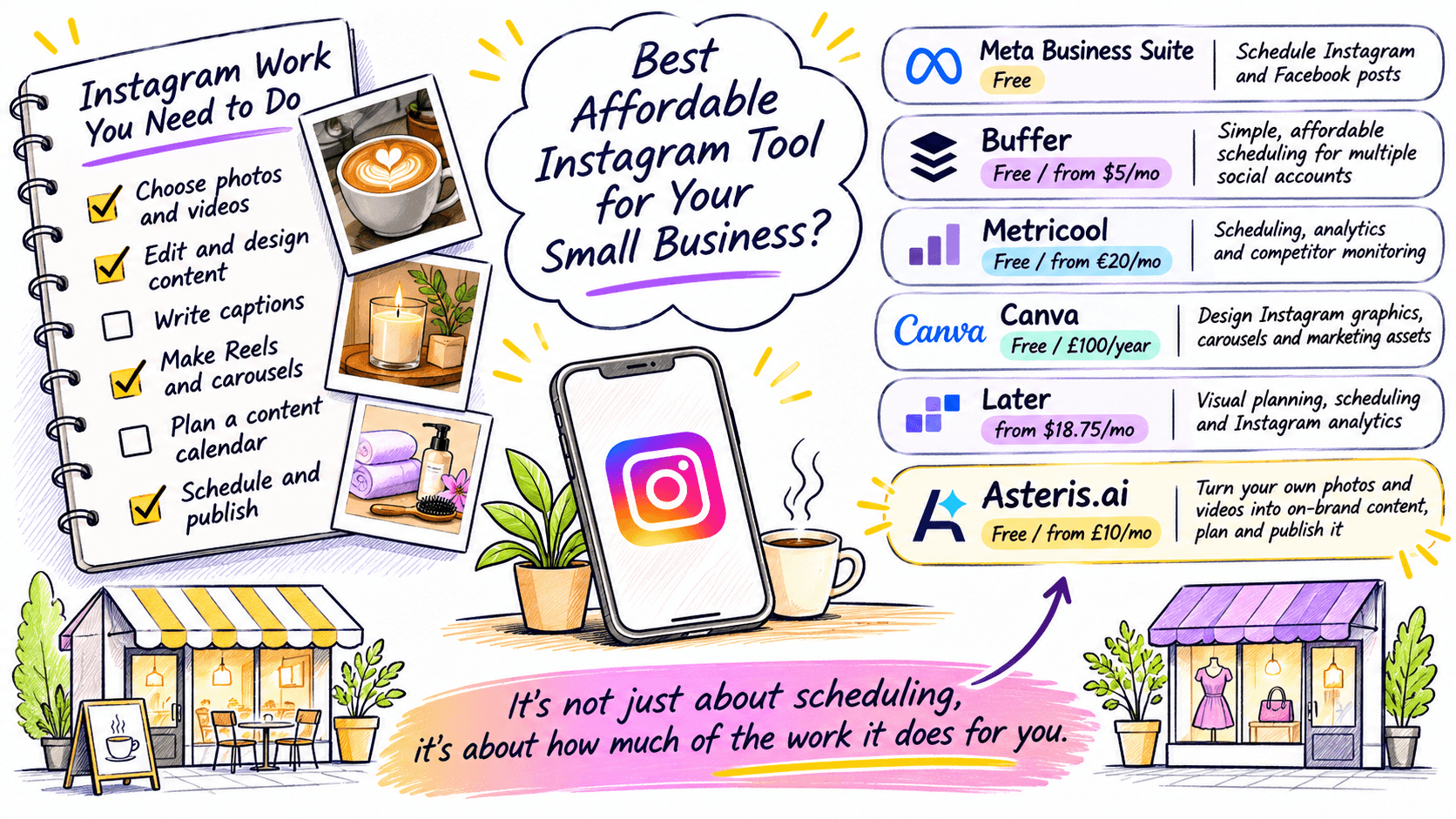
The best affordable Instagram tool depends on what a small business needs help doing. Meta Business Suite and Buffer are strong low-cost choices for scheduling finished posts. Asteris.ai starts at £10 a month for businesses that also need help turning their own photos and videos into content.
A café owner can take twenty good photos during service and still have nothing ready to post next week. A boutique might have an entire folder of product images but no time to turn them into a coherent Instagram feed. Choosing an affordable Instagram tool starts with understanding where that work gets stuck, because a free scheduler and an AI content assistant solve different problems.
Start With the Free Tools
Instagram already provides more free publishing functionality than many small businesses realise. Its native professional tools offer analytics, content creation features and account management, while Meta Business Suite provides a way to plan and schedule content across Instagram and Facebook without paying for a separate subscription.1 For an owner posting twice a week who already knows what to publish, this may be entirely sufficient. Paying for another scheduler would add a bill without necessarily removing any meaningful work.
Buffer offers a more structured alternative when a business wants to manage multiple social accounts. Its free plan supports up to three channels, with ten scheduled posts per channel at a time, and those scheduling slots become available again as posts are published.2 This distinction matters because the limit is on the scheduled queue rather than a fixed allowance of ten published posts per month. A small business maintaining Instagram, Facebook and LinkedIn could find that the free plan covers its immediate publishing needs.
Metricool takes another approach, combining scheduling with analytics and competitor monitoring. Its free tier allows one brand, up to twenty scheduled posts per month, thirty days of analytics history and analysis of five competitor profiles.3 For a shop owner who already produces content but wants a clearer picture of what performs, that is a useful combination. The monthly publishing limit becomes relevant when the business starts posting more frequently or expanding its content calendar.
There is little reason to pay for scheduling alone before testing these free options. The savings become more substantial when the business needs help with the work that happens before a post is ready: choosing media, producing videos, writing captions, keeping the brand recognisable and deciding what belongs in next week's calendar. Some tools tackle those tasks directly, while others leave most of them with the owner. That is where the pricing comparison becomes more interesting.
What the Prices Include
The affordable end of the Instagram software market now includes free publishing tools, low-cost per-channel subscriptions, design platforms and AI-powered content systems. These categories overlap, but their pricing models are different enough that comparing monthly fees alone can be misleading. A $5 scheduler may be cheaper than a £10 content tool, while requiring substantially more manual preparation. A design subscription can be excellent value for someone who enjoys making posts and less useful to someone who has no time to design them.
Here is a snapshot of relevant plans and publicly advertised prices, checked on 19 November 2026.
| Tool | Starting price | Best suited to |
|---|---|---|
| Meta Business Suite | Free | Scheduling finished Instagram and Facebook content |
| Buffer | Free; Essentials from $5/month per channel, billed annually | Straightforward scheduling across multiple social platforms |
| Metricool | Free; Starter from €20/month | Scheduling, analytics and competitor monitoring |
| Canva | Free; Pro £100/year per person | Designing Instagram graphics, carousels and marketing assets |
| Later | Starter from $18.75/month, billed annually | Visual content calendars and multi-platform scheduling |
| Asteris.ai | Free starter quota; Base £10/month, Plus £16/month, Pro £20/month | Creating, planning and publishing on-brand Instagram content from original media |
Prices are advertised in different currencies and billing terms. Annual discounts, taxes, regional pricing, quotas and feature limits can change the actual cost. Check the current plan before subscribing.2345
Buffer's Essentials plan is attractive when publishing is the main requirement. At the advertised annual-billing rate of $5 per month for one connected channel, it provides unlimited scheduled posts subject to its fair-use policy, alongside AI assistance and more advanced analytics.2 The price rises as the business connects additional channels, although Buffer offers volume discounts at larger account counts. For an owner running one Instagram account, the cost can remain very modest.
Later's Starter plan costs more, but includes a visual planning workflow, a social set covering profiles across supported networks, recommended posting times, Instagram analytics and a link-in-bio feature. It also includes five monthly AI credits and allows thirty scheduled posts per profile each month.4 Those limits are worth examining before subscribing, especially if the business intends to reuse the tool across several campaigns. Later becomes more attractive when visual feed planning and managing multiple social platforms matter more than keeping the subscription at the lowest possible price.
Canva presents a different calculation. Its free version covers a great deal of everyday design work, while Canva Pro adds premium templates, stronger editing tools, brand kits and social scheduling at a UK annual price of £100 for one person.5 Canva's Content Planner can schedule supported designs to Instagram Business accounts, although scheduling requires an eligible paid plan and has platform-specific requirements.6 For a small business that creates menus, promotional flyers, product graphics and Instagram carousels, the wider design capabilities may justify the cost.
Asteris.ai occupies another part of the comparison. Its free plan provides a starter AI quota, while its £10 Base plan is geared towards regular image-led content and the £16 Plus plan adds substantially more AI quota for image and video creation. Unlike pricing based primarily on connected accounts or publishing slots, its usage model covers AI content generation and refinement. Businesses should evaluate how much usable content their quota produces rather than assuming every plan corresponds to a fixed number of posts.
Scheduling Isn't Making Content
Consider the difference between scheduling twelve posts and preparing twelve posts. A scheduler handles the final step once the images, captions, hashtags and publishing dates are ready. Someone still has to decide which photos deserve attention, edit the visuals, write the copy, make any Reels and organise the sequence. For a restaurant owner or salon manager, that preparation can be a much larger commitment than pressing Publish.
A business with a dedicated marketing assistant may have little difficulty producing content. The assistant can spend an afternoon choosing images, writing captions and assembling a calendar, then use Buffer or Meta Business Suite to schedule everything efficiently. For this business, a simple scheduling tool may offer the best value because the creative work is already covered. Buying more automation would make sense only if it improved the existing process.
A one-person business faces a different problem. The same person might be preparing food, serving customers, managing bookings, ordering supplies and taking product photos. Content ideas often accumulate in a phone gallery because there is no dedicated time to turn them into finished posts. A cheaper tool that expects ready-made content cannot remove that particular bottleneck.
This is the reason to consider an AI content tool alongside a traditional scheduler. Asteris.ai is designed to work from a business's own photos and videos, using its website and brand context to help prepare captions, image posts and video content for review, scheduling and publishing. The owner can refine drafts before they go live rather than starting each post from a blank page. Its value depends on whether that preparation assistance saves enough time to justify the subscription and available AI quota.
AI assistance is not unique to Asteris.ai, and the distinction should not be exaggerated. Buffer offers an AI assistant, Later provides AI content credits, Canva has extensive AI design features, and Metricool includes AI assistance in its offering.2 The more useful comparison is how each product connects that assistance to the business's real media and publishing workflow. A tool that drafts a caption is different from one that helps select existing photos, build a video and prepare a week's content.
Original Media Has Value
A business's own content is often its strongest advertising material, particularly on Instagram. A restaurant's food photographs show what customers can actually order, while salon treatment results demonstrate the quality of the work. An online product brand can show how an item looks in different settings, and a boutique can feature real outfits rather than generic fashion imagery. These are details that stock-style AI visuals cannot reliably reproduce.
There is also a platform reason to take original content seriously. In January 2026, Meta reported that 75% of Instagram recommendations in the United States during the fourth quarter of 2025 came from original posts, following changes that increased the prominence of original content.7 That figure does not mean every original business photograph will receive more reach or that AI-assisted editing is penalised. It does support a strategy built around authentic source material rather than repeatedly publishing recycled or interchangeable content.
The format matters as well. Metricool's 2026 Instagram study analysed more than 24.3 million posts across 375,000 accounts and found that Reels generated more than four times the interactions of single-image posts. Carousels generated nine times more saves than single images, suggesting that businesses should think about what each format is supposed to achieve.8 A short Reel might introduce a new dish to people who have never visited, while a carousel showing a complete menu or styling options could be useful enough to save.
These findings should influence the software purchase. A restaurant with plenty of food footage might benefit from help assembling short videos, while a product business with detailed photography could prioritise carousel creation and planning. Someone who already makes excellent Reels may need better reporting or scheduling instead. The right tool should help the business use the content it can realistically produce, rather than encouraging a constant search for new material.
Match the Tool to the Shop
For a café or restaurant, the biggest advantage often comes from turning routine activity into regular content. New dishes, preparation footage, changing specials and a busy dining room all create useful material, provided the owner has permission to publish anything involving customers or staff. If the team can assemble these posts independently, Buffer or Meta Business Suite may be enough. When the photos and clips are available but preparation keeps slipping, a media-led tool such as Asteris.ai becomes more relevant.
A hair or beauty salon has another consideration: the work itself is a portfolio. Before-and-after photographs, styling videos and explanations of treatments can demonstrate expertise far better than generic promotional graphics. Canva may be especially valuable when the salon wants beautifully designed educational carousels and branded service announcements. Asteris.ai may suit a salon that wants its own client-result media organised into recurring Instagram content without manually preparing every caption and video.
For boutiques and fashion businesses, visual consistency matters alongside product discovery. A small shop launching a seasonal collection could use Canva to create polished campaign graphics, Later to arrange the visual feed and schedule the collection's rollout, or Asteris.ai to build more of that content from the shop's own imagery. The choice depends on how much creative work the owner wants to do personally. A well-designed feed is valuable, but customers still need to see the actual clothes, accessories and styling ideas being sold.
An ecommerce business may place greater weight on measurable outcomes. Product demonstrations, customer questions, launch announcements and repeat-purchase reminders each have different purposes on Instagram. Metricool's analytics and competitor monitoring can be useful when the owner wants to understand content performance across channels.3 For a Shopify or Etsy seller struggling to produce posts in the first place, easier content preparation may deserve priority before investing in more detailed reporting.
The smallest possible software bill is not necessarily the lowest operating cost. A business paying nothing for scheduling while spending four hours every week preparing content has made a different trade-off from one paying £10 or £16 for a workflow that reduces that preparation. The subscription price is easy to measure, while the owner's time is frequently left out of the calculation. Both belong in the buying decision.
Run a Two-Week Trial
Before choosing a paid Instagram tool, test it against a real fortnight of content rather than a polished product demonstration. Gather the photos and videos the business already owns, choose a realistic number of posts and work through the complete process from selecting media to scheduling. Do not judge the tool by how quickly it generates its first caption. Measure how much time it takes to produce content the business would genuinely be happy to publish.
A useful test should answer five practical questions:
The results should be judged against the business's actual goals, rather than promises about reach. Buffer's October 2026 explanation of Instagram ranking highlights watch time, likes per reach and sends per reach as important signals, with original content also receiving favourable treatment.9 For a restaurant, however, bookings and enquiries may matter more than maximising views. A salon might care about consultation requests, while a product brand should also look at website visits and sales.
Two weeks will not prove that a particular subscription increases revenue. It can reveal whether the tool is practical enough to use regularly, whether its limitations are manageable and whether its output fits the brand. That is particularly important with AI allowances, because repeated regeneration and editing may use quota before the business has anything ready to publish. A small test with real content is more informative than choosing a plan solely because it advertises hundreds of AI features.
Pay for Work You Skip
For a small business with finished content ready to go, free scheduling is a sensible starting point. Meta Business Suite costs nothing, Buffer provides a generous entry point for several channels, and Metricool adds useful analytics to its free publishing allowance. Owners who enjoy design work should consider Canva, while Later is a stronger candidate for those who value structured visual planning across social profiles. Each offers a reasonable answer to a different version of the affordability question.
The decision changes when a business has plenty of original photos and videos but struggles to turn them into regular Instagram posts. In that situation, Asteris.ai's combination of brand-aware content preparation, image and video creation, planning and publishing is worth comparing with a basic scheduler. Its £10 and £16 tiers sit within the budget many small businesses might consider for marketing software, although the AI quota still needs to fit their workload. An affordable Instagram tool earns its place when the owner can maintain a better feed without turning content creation into another demanding job.
Sources
Footnotes
Overview of Instagram's native tools and affordable options for small businesses, Hootsuite, 27 Best Instagram Tools for Marketers in 2026↩
Buffer's Free, Essentials and Team subscription prices, channel allowances and publishing features, Buffer Pricing↩↩2↩3↩4
Metricool's Free and Starter plans, publishing limits and analytics features, Metricool Pricing↩↩2↩3
Later Starter pricing, social sets, scheduling limits and AI allowances, Later Pricing↩↩2
Canva's UK Free and Pro plans, design tools and pricing, Canva Pricing↩↩2
Canva's supported social platforms and Content Planner scheduling requirements, Canva Help Centre↩
Meta's January 2026 disclosure on original Instagram content recommendations, Meta, 2026: AI Drives Performance↩
Research covering 24.3 million Instagram posts and format performance, Metricool, 2026 Instagram Study↩
Instagram ranking signals, originality and content recommendations, Buffer, How the Instagram Algorithm Works: Your Up-to-Date 2026 Guide↩