
Instagram Post Ideas for Salons That Prove the Work
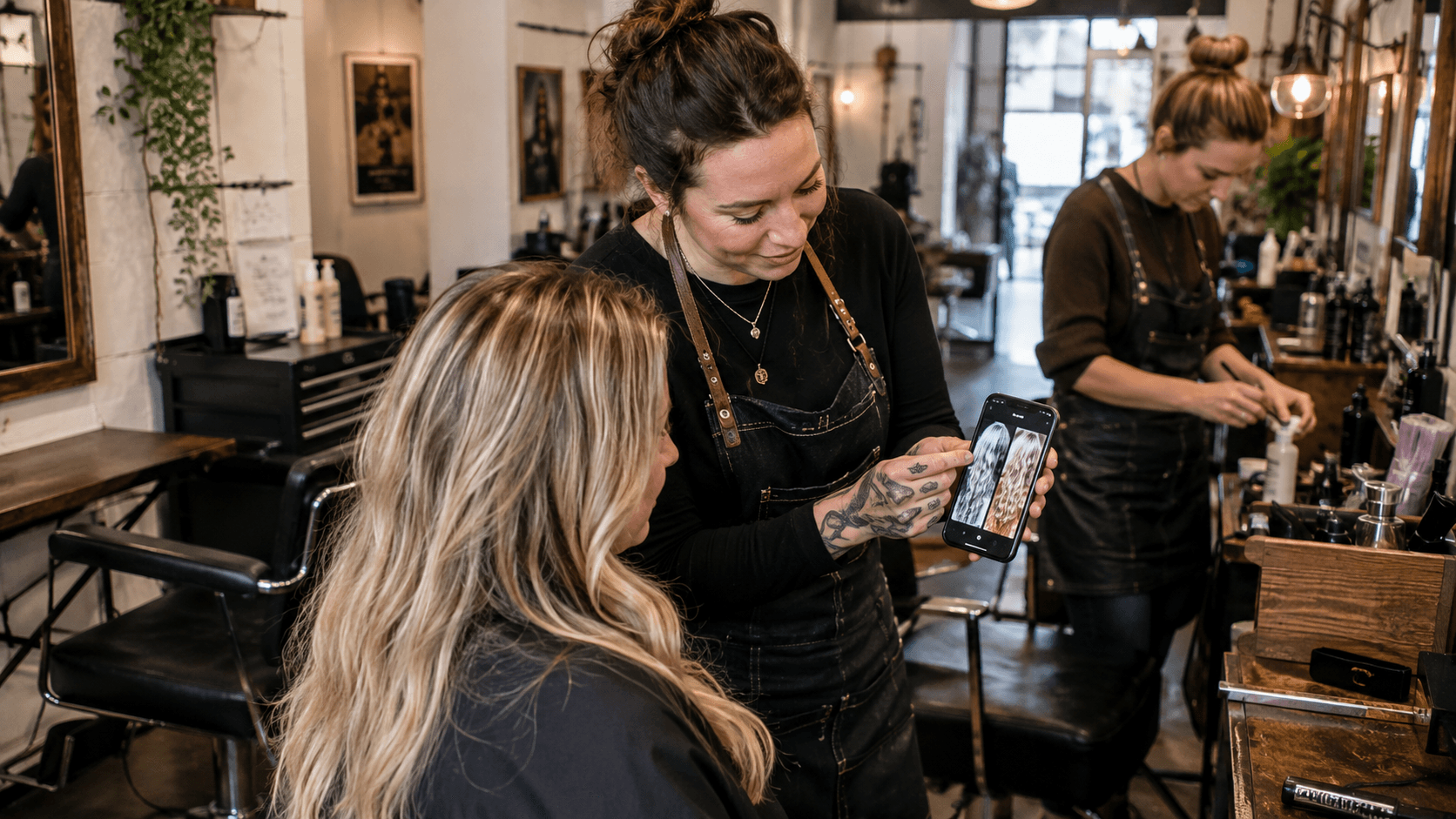
The best Instagram post ideas for salons show proof. Use before-and-after posts for visible change, client result posts for trust, and behind-the-scenes posts for process. Turn each appointment into a small story with consent, clear lighting, local context, and a simple booking path.
Most salons already have the raw material for good Instagram content. It is sitting in the camera roll, the client chair, the colour bowl, the mirror shot, and the quick thank-you message after an appointment. The problem is rarely lack of content. The problem is that too much salon content shows a finished look without helping a stranger understand why they should trust the person behind it.
Results need a story
Before-and-after posts work because they make change visible. For salons, that visual proof matters more than polished copy, because clients are not buying an abstract service. They are imagining their own hair, skin, brows, lashes, or nails in your chair. SocialInsider’s 2026 Instagram benchmarks found carousels slightly ahead of Reels for engagement, with Reels still close behind, which makes swipeable proof especially useful for service businesses that need to show detail.1
A single final photo can look good and still fail to persuade. A potential client wants to know what changed, how difficult the work was, whether the result suits real life, and whether the stylist understood the brief. That is why the best salon before-and-after posts are not simply two images placed side by side. They give enough context for someone to believe the result.
A strong before-and-after carousel can follow a simple sequence. Slide one shows the final result, because Instagram is still a visual platform and the first frame has to earn attention. Slide two shows the before photo in the same lighting if possible. Slide three explains the client’s goal, slide four shows a process detail, and slide five gives care advice or a booking prompt.
This structure also avoids one of the common problems with salon feeds. Many accounts post result after result until every image starts to feel interchangeable. When you add the story, the work becomes more specific. A copper correction, a low-maintenance blonde refresh, a brow shape for sparse growth, or a gel set for a client who uses their hands all day suddenly becomes easier to understand.
Before-and-after needs discipline
Before-and-after content is powerful, but only when it is fair. If the before photo is taken under bad light and the after photo is taken under warm, flattering light, the post starts to feel manipulated. Salon Guru advises consistent lighting, a clear background, and careful focus so the quality of the work is visible rather than lost in clutter.2 For salons, this is not only a photography tip. It is a trust signal.
Set up one small photo routine that every stylist can follow. Use the same wall or corner, face the client towards the light, remove gowns or hair clippings before the final shot, and take more than one angle. For hair colour, include movement shots if the tone changes in different light. For lashes, brows, nails, or skin, include close detail without making the image feel invasive.
A practical before-and-after checklist can be short:
Consent deserves to be treated as part of the workflow, not a last-minute question. The Australian Beauty Association recommends written, informed consent before taking and sharing client photos or videos, including where the images will be used and whether the client can later revoke permission.3 That advice is especially relevant for beauty businesses because treatment images can identify a person, reveal personal preferences, or show areas of the body a client may not want made public.
This is where many salons can quietly stand out. A client who feels respected is more likely to say yes, tag the salon, and come back. A client who feels pressured may still allow the photo, but the relationship has been weakened. The best content systems make it easy to say yes and completely acceptable to say no.
Client results beat generic praise
Client result posts are different from before-and-after posts. A before-and-after shows visible change. A client result post shows the outcome in the client’s life. That might be a bride’s hair still holding at the end of the evening, a colour that grows out softly after eight weeks, a manicure that suits someone’s work, or a facial result that made a client feel more comfortable going makeup-free.
This matters because the strongest salon marketing is not only about technical skill. It is about reducing uncertainty. A new client is wondering whether the stylist can work with their hair type, their budget, their maintenance habits, and their comfort level. A good client result post answers one of those questions without sounding like a sales pitch.
Testimonials can work, but they are stronger when paired with specifics. Instead of posting a quote that says “I love my hair”, explain what the appointment solved. Was the client nervous about going shorter? Did they want colour that would not need constant salon visits? Did the stylist soften a previous colour line, reshape grown-out layers, or create brows that looked natural rather than overdone?
There are several useful client result formats:
These posts also give salons a reason to talk about judgement. A client does not always know the technical name for what they want. They may bring three reference photos that cannot all be achieved on their hair in one sitting. Showing how the stylist interpreted the brief makes the salon look thoughtful, honest, and skilled.
Behind-the-scenes builds belief
Behind-the-scenes content is often treated as filler. A quick colour bowl clip, a stylist mixing product, a mirror shot before opening, a trolley reset at the end of the day. These posts can feel small compared with glossy results, but they do important work. They show that the result did not appear from nowhere.
Sprout Social recommends using Reels when voice and emotion are central to a story, and carousels when the story needs more detail or context.4 That distinction is useful for salons. A stylist explaining why a colour correction takes time is often better as a Reel. A step-by-step breakdown of a brow lamination or bridal trial is often better as a carousel.
Behind-the-scenes posts are also where independent salons can show their difference from chains or very polished influencer-style accounts. The consultation, the patch test reminder, the quiet care taken with a nervous client, the clean station, the second opinion from another stylist, the choice not to do a service that would damage the hair. These moments are not glamorous in the obvious sense. They make the salon feel safer.
Good behind-the-scenes content can be simple:
This is also where AI-generated stock-style content falls apart. A salon does not need invented images of perfect hair in a perfect room. It needs to make better use of its own real material. Asteris is built around that idea for small beauty businesses, helping salons turn their own media and brand voice into Instagram posts without making the feed feel generic or detached from the people doing the work.5
Format follows the job
The best post format depends on what the post needs to achieve. Reels are useful when movement matters, such as a hair swish, a reveal, a treatment process, or a stylist talking through an issue. Carousels are useful when the viewer needs to compare, understand, save, or decide. Stories are useful for lower-pressure updates, availability, polls, reposting tags, and keeping regular clients close.
Hootsuite notes that Instagram carousels can include up to 20 photos or videos, giving brands more room to show a process, reveal, tutorial, or detail sequence.6 That extra room matters for salons because many services are not understood from the final image alone. A colour correction may need process shots. A facial may need a calm explanation. A nail design may need close-ups from several angles.
A practical weekly salon mix might look like this. Post one proof-led carousel, one short Reel with movement or voice, one educational post that answers a common client question, and several Stories that show availability, repost client tags, or share small daily moments. This gives the feed enough consistency without asking the owner or stylists to become full-time content creators.
The mistake is to let the format lead the strategy. If every idea becomes a Reel because Reels feel important, you may lose the detail that helps people choose. If every result becomes a static image, you may lose the movement and personality that makes the salon memorable. Start with the job of the post, then choose the format.
Local proof matters
Salon Instagram is not the same as influencer Instagram. A salon does not need to be interesting to everyone. It needs to be trusted by people close enough to book. Setmore makes this point clearly in its salon Instagram guidance, noting that salons need local relevance and booking routes, not only views and likes.7
This changes the kind of caption that works. A caption that says “soft balayage refresh for spring” is fine, but it could belong to almost any salon. A more useful caption says who the service is for, how long it took, what maintenance looks like, and what kind of appointment to book. It helps the right person recognise themselves.
Local context can appear naturally. Mention the branch, neighbourhood, stylist, appointment type, or aftercare routine. Add location tags where relevant. Use Highlights for prices, services, testimonials, colour corrections, bridal work, FAQs, or first-visit information, so a new visitor can quickly understand what to do next.
This is also why not every post should chase broad reach. A behind-the-scenes post about how your Cambridge salon handles first colour consultations may not go viral, but it can help a nervous local client send a DM. A carousel explaining how often to refresh a lived-in blonde may get fewer likes than a dramatic reveal, but it may bring in better-fit bookings.
A salon feed should earn trust
The best salon Instagram post ideas are not random ideas. They are a way of building proof over time. Before-and-after posts show the visible change. Client result posts show the human outcome. Behind-the-scenes posts show the care, judgement, and process behind the result.
That combination matters because Instagram is crowded with polished images. The feed that stands out is not always the glossiest one. It is the one that helps a potential client think, “They understand people like me.” That is a more valuable response than a passive like.
For most salons, the next step is not to post more. It is to stop treating every photo as a finished asset and start treating each appointment as a story with evidence. One appointment can produce a before-and-after carousel, a care tip, a process Reel, a Story poll, and a client result post later. The content is already there.
A useful salon content system respects the client, protects the brand, and makes the work easier to believe. That is where AI can help when it is grounded in the salon’s real media, not when it invents content from thin air. The strongest salon feeds will still feel human, local, and specific. They will simply be better organised.
Sources
Footnotes
Instagram format engagement benchmarks for Reels, carousels, and images, SocialInsider↩
Practical salon photography advice on lighting, backgrounds, and focus, Salon Guru↩
Consent guidance for taking and sharing client photos and videos in beauty businesses, Australian Beauty Association↩
Instagram trend guidance on choosing Reels for emotion and carousels for detail, Sprout Social↩