
Your Next Client Is Already Scrolling Past You
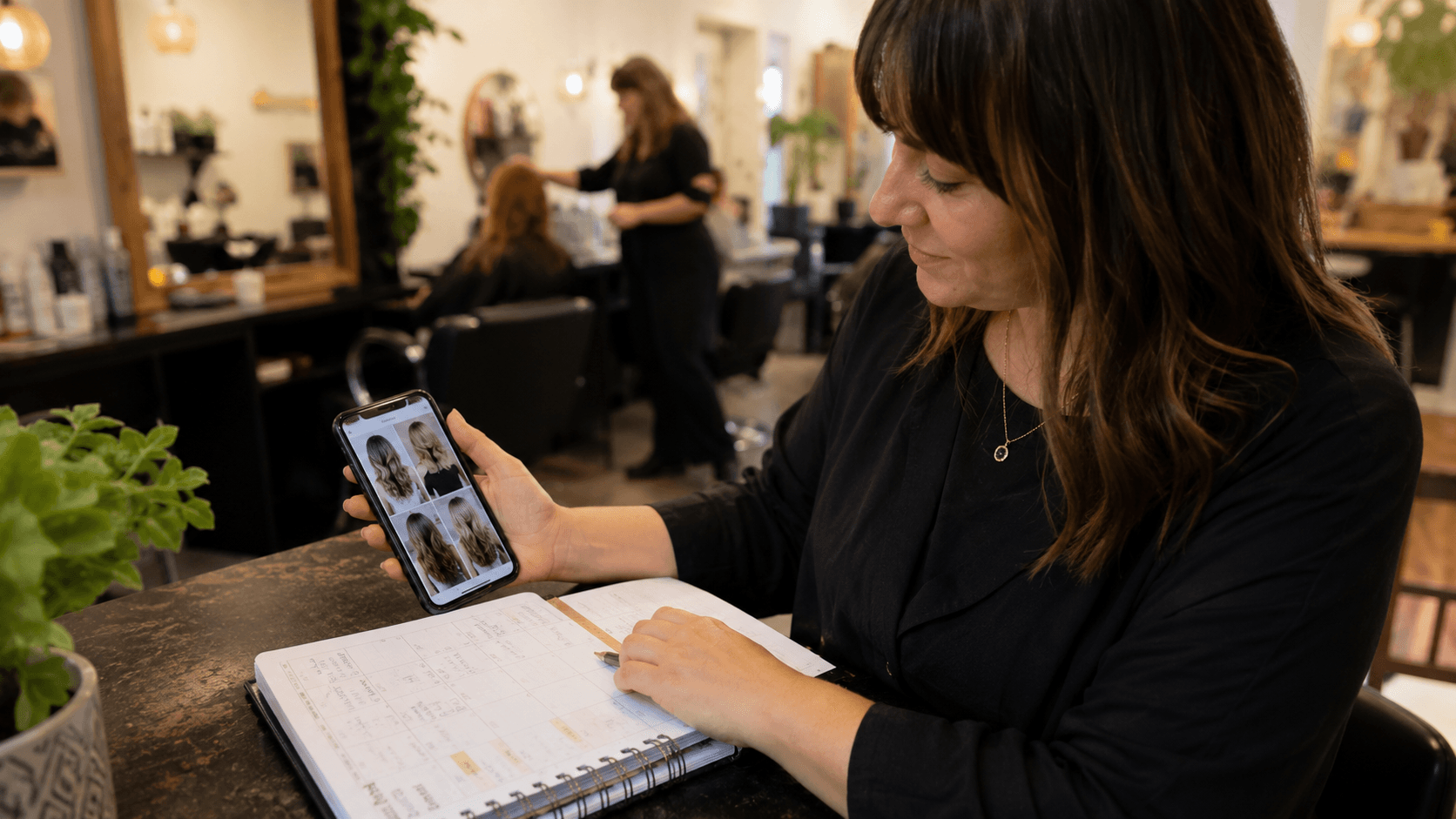
Salons attract new local clients on Instagram by treating their profile as a local search and trust asset. That means showing real client results, using clear service and location language, tagging relevant places, and making booking easy. Reels create discovery, carousels build confidence, and Stories keep warm clients close.
There is a version of salon Instagram that most owners already know. Post a nice photo of a blow-dry, add a few hashtags, hope someone sees it, then repeat when there is time. That approach does not match how people now discover local services, because Instagram has become part of the decision path before a client ever calls, messages, or books.
Instagram Is Local Search
Instagram is now too large to treat as a side channel. Reuters reported in September 2025 that Instagram had reached 3 billion monthly active users, while Hootsuite's 2026 statistics highlight that Reels account for 46% of time spent on the platform and are shared more than 4.5 billion times per day.12 For salons, the important point is not the global scale, but the way that visual content now shapes local decisions.
A few years ago, a Google executive said that many young people were using TikTok and Instagram instead of Google Maps or Search when looking for places such as lunch spots.3 That quote is often stretched too far, so it should not be treated as proof that every local search has moved to social media. But it does show a real behavioural shift: people increasingly use visual platforms to decide where to go, what to buy, and who to trust.
For salons, that shift is good news. A salon does not need a national audience, a viral trend, or a huge follower count to win from Instagram. It needs to appear credible to people nearby who are already thinking about hair, nails, lashes, brows, skin, colour, or beauty treatments.
Make The Profile Bookable
Before a new client watches five Reels, she usually lands on the profile. Sprout Social describes an Instagram profile as a discoverability surface for small businesses, with the Name field, bio, mission, and call to action all helping visitors understand who the business serves and what to do next.4 For salons, this means the profile should read less like a slogan and more like a useful booking page.
The Name field should contain the service category and location, because those are the words a local client is likely to search. "Bloom Hair Studio" may be the brand, but "Hair Colour Salon Cambridge" gives Instagram and humans more context. A vague bio such as "Making you feel beautiful" may sound warm, but it does not help someone decide whether you do curly cuts, BIAB nails, lash lifts, bridal hair, skin treatments, or colour correction.
The profile also needs a low-friction next step. Instagram lets business accounts add action buttons such as appointment booking, while contact and location information help people understand how to reach the business.5 Highlights should be treated as practical proof, with folders for prices, first visits, colour work, nails, skin, reviews, FAQs, and aftercare.
Geotags Are Storefront Signals
A salon's physical location is part of its value. Clients want to know whether the salon is nearby, easy to reach, and part of their normal routine. That is why location tags, neighbourhood language, and local hashtags should not be treated as optional decoration.
Instagram SEO guidance from Later explains that the platform's search bar helps users find accounts, keywords, hashtags, places, posts, and audio.6 Sprout Social's Instagram SEO guidance also notes that location tags can help local businesses appear when users search for specific places.7 For a salon, this means a post about "soft brunette balayage" becomes more useful when it also clearly signals where the service is offered.
The aim is not to stuff every caption with awkward local keywords. It is to write the way clients search and speak. A useful caption might say, "Soft brunette balayage in Cambridge for clients who want a lower-maintenance grow-out," because it combines service, location, client need, and result in one natural sentence.
Results Beat Polish
Salon Instagram content has a natural advantage because the service is visual. The mistake is thinking that every result needs perfect lighting, trending audio, and a heavily edited finish. For a local client, a clear real result is often more persuasive than a polished video that feels like an advert.
The strongest salon posts usually include context around the result. A colour transformation is more useful when the caption explains the starting point, the goal, the number of sessions involved, the maintenance required, and the product advice given afterwards. This makes the stylist's expertise visible, which matters because a new client is buying judgement as much as the final look.
This is also where AI should be used carefully. A salon's own photos and videos are the asset, because they show real clients, real hands, real chairs, and real outcomes. Asteris is built around that principle: it works from a business's own media and brand voice, then helps turn those assets into planned, on-brand Instagram content with a human approval step before anything goes live.
Generic beauty content may fill a feed, but it does not prove that this team can fix warm banding, shape brows sympathetically, or recommend a nail design that suits a client's job and lifestyle. The content should elevate what the salon already does well. It should not replace the salon's real work with stock-style perfection.
Reels Reach Strangers
Reels are one of the most useful formats for getting in front of people who do not follow the salon yet. Buffer's 2026 guide explains that Instagram uses different ranking systems across Feed, Stories, Reels, and Explore, with Reels shaped by signals such as watch behaviour and shares.8 Sprout Social also advises brands to use a strong hook in the first three seconds of a Reel to hold attention.9
For salons, this does not mean filming complicated skits. A useful Reel can be a seven-second fringe refresh, a 15-second colour reveal, a nail set from bare to finished, or a stylist explaining who should avoid a certain treatment. The opening frame should tell the viewer why to keep watching, not make them wait for the result.
The local layer is what turns reach into potential bookings. A Reel about "soft brunette balayage" is fine, but "soft brunette balayage in Cambridge for low-maintenance grow-out" is stronger. It gives Instagram more context, gives local clients a reason to care, and signals that the salon understands a real need rather than chasing a vague trend.
A practical salon Reel system can stay simple. The aim is to repeat useful formats, not repeat identical posts. It could include the following recurring formats:
The point of recurring formats is not to make the feed repetitive. It is to reduce the decision load on the owner, stylist, or front-desk person who is trying to create content between appointments. Once the format is clear, the salon can capture small pieces of real work and turn them into consistent discovery content without starting from a blank page each time.
Carousels Build Confidence
Reels can introduce a salon to strangers, but carousels are often better at slowing people down. Hootsuite's 2026 social media benchmark report found that carousels were the strongest Instagram content type in its dataset.10 For salons, that makes sense because booking confidence often grows through details.
A carousel gives space for comparison, explanation, and reassurance. Instead of posting one finished haircut, a salon can show the client brief, the starting point, the cut in progress, the finished shape, and the maintenance note. Each swipe becomes a small trust signal, especially for clients who are nervous about trying somewhere new.
Carousels are also useful for services that need education. Skin treatments, colour correction, extensions, brow lamination, curly cuts, bridal styling, and nail health all benefit from explanation. A well-made carousel can answer the practical questions that stop clients booking, such as how long the result lasts, who it suits, what aftercare is needed, and when a consultation is recommended.
A simple carousel structure is enough for most services. The detail can change with each treatment, but the decision path remains familiar. Start with this sequence:
This format works because it respects the decision. A new client is not only asking whether the result is pretty. She is asking whether the salon listened, whether the advice sounds honest, whether the maintenance feels realistic, and whether the team seems experienced enough to trust with her appointment.
Clients Are Content Partners
The most persuasive salon content often comes from clients. A tagged post-appointment selfie, a Story showing a new colour, or a short reaction clip in the chair can carry a credibility that polished brand content cannot always match. That is because the decision to try a new stylist, nail technician, brow artist, or beauty therapist feels personal.
Building a steady stream of client content requires a simple system. A stylist can ask permission to capture the finished look, the salon can create a well-lit photo spot, and the front desk can remind happy clients to tag the salon if they share the result. Consent matters, so the salon should be clear about whether the content can be reposted, saved, or used in future marketing.
Once captured, client content should not disappear after a single Story. A strong transformation photo can become a carousel, a Reel, a Highlight, a website testimonial, or a future seasonal post. This is where planning tools help, because the value is not only in capturing the content, but in turning it into a steady rhythm that supports bookings over time.
What Should Salons Post?
Content consistency is what separates salons with a growing Instagram presence from salons that post in bursts and disappear. The problem is rarely a lack of things to show. The problem is that content creation gets pushed to the end of the day, which means the salon is quiet online precisely when the team is busy producing its best work.
A simple weekly framework removes the guesswork. Most salons need a balance of results content, educational content, trust-building content, local content, and light promotional content. The mix should make the salon easier to understand, not louder for the sake of being louder.
Useful salon content categories include:
Each of these can be captured during a normal working day. The content does not need to be produced from scratch during a separate content day. It needs to be collected as a byproduct of real work, then planned and scheduled so the salon stays visible even when the team is busy.
Measure Booking Intent
Likes are pleasant, but they are not the main metric for a salon. Sprout Social's small business guide recommends tracking metrics such as saves, shares, profile conversion, link clicks, and revenue attribution rather than relying on vanity metrics alone.4 For salons, the useful question is narrower: which content creates booking intent?
A salon should track DMs, profile visits, website taps, booking link clicks, saves, shares, Story replies, and appointment requests. A Reel with fewer likes but three consultation DMs may be more valuable than a viral trend that attracts followers from outside the area. A carousel that gets saved repeatedly may be doing serious work because clients return to it before booking.
This measurement also improves planning. If curly cut education drives saves, make it a monthly content pillar. If bridal hair behind-the-scenes creates enquiries, build a seasonal series. If last-minute cancellation Stories fill empty slots, treat them as part of the operating rhythm rather than an afterthought.
The Feed That Fills Chairs
The salons that win on Instagram are not always the ones with the most dramatic transformations. They are often the ones that feel easiest to find, easiest to understand, easiest to trust, and easiest to book. Local clients do not need a perfect feed, but they do need enough evidence to feel that their appointment is in safe hands.
That evidence comes from real work shown consistently. It comes from local signals, service keywords, visible results, human explanations, useful Highlights, and clear booking paths. When those pieces work together, Instagram stops being a chore and starts behaving like an always-on shop window for the salon.
The practical implication is simple. Salons should stop asking, "What can we post today?" and start asking, "What would help a nearby client choose us this week?" That shift turns Instagram from a content treadmill into a local client acquisition system.
Sources
Footnotes
Google executive comments on young people using Instagram and TikTok for place discovery, TechCrunch↩
Strategic guide to Instagram marketing for small businesses, Sprout Social↩↩2
Instagram Help guidance on action buttons for business accounts, Instagram Help↩
Instagram SEO guidance including location tags for local discovery, Sprout Social↩
Instagram best practice guidance for Reels and hooks, Sprout Social↩