
Authenticity and Automation Start in the Kitchen
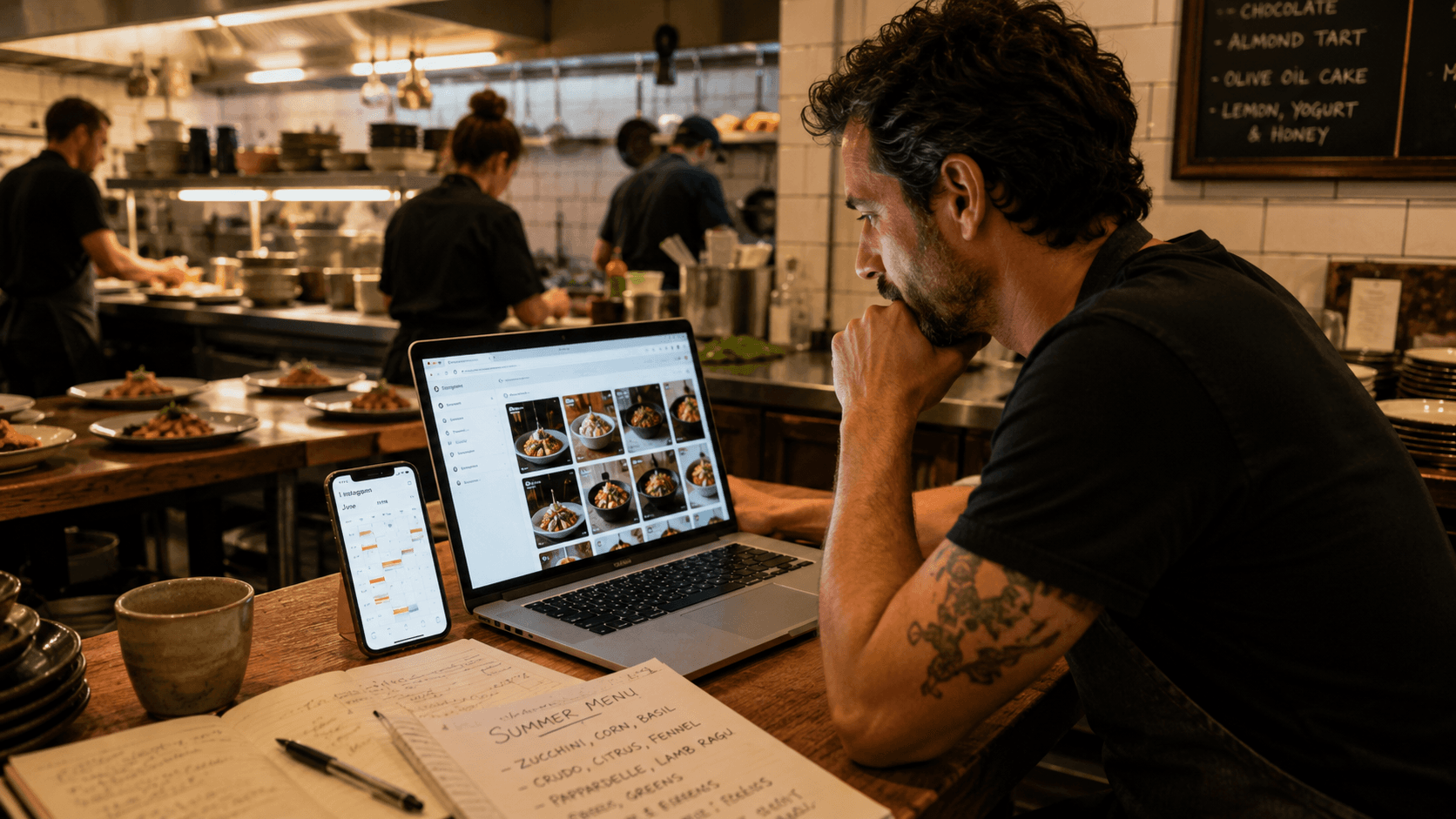
Restaurant Instagram posting can be automated without losing authenticity when the system starts with the restaurant's own photos, menu, room, people and voice. AI should help turn real material into consistent post ideas, captions and schedules, while the restaurant keeps approval and final judgement.
Most restaurant owners know they should be posting on Instagram more often. The problem is not awareness. The problem is Tuesday at 2pm, when the lunch rush has ended, evening prep is starting, and nobody has time to choose a photo, write a caption and schedule a post. So nothing goes up.
Again.
That is the cycle that pushes restaurants towards automation. On paper, it sounds like the obvious fix: set up a tool, let it handle the posting, and free the team to focus on food and guests. But anyone who has scrolled past a restaurant account full of generic food images and captions that sound like a machine pretending to be warm knows what bad automation looks like. It looks like a restaurant that has stopped sounding like itself.
The wrong kind of automation
The standard social media automation playbook was not built for restaurants. It often assumes a tidy library of polished assets, a brand guidelines document, and a content calendar planned weeks in advance. Most independent restaurants have something messier and more useful: a phone full of photos taken during service, a rough instinct for what regulars respond to, and maybe one person on the team who is good at Instagram but also has three other jobs. That is not a weakness. It is the reality the system has to work with.
When restaurants plug into generic automation tools, the output often starts to drift. Captions sound like they could belong to any restaurant in any city. Seasonal specials get missed because the system does not know what is happening this week. The room, the staff, the regulars and the small local details disappear from the feed. The restaurant may post more often, but it starts to feel less believable.
The problem is not automation itself. The problem is automation that does not start from the restaurant's own identity. For a restaurant, authenticity is not a tone setting or a few friendly phrases in the caption. It is evidence: the actual dish, the actual room, the actual counter, the actual light, and the voice that customers already recognise.
The cadence problem
Instagram rewards regular activity, but restaurants cannot treat posting like a factory line. Buffer's 2025 analysis found that posting 3 to 5 times per week on Instagram was a strong range for growth and reach without burning out the account.1 Hootsuite gives similar guidance for business accounts, recommending 3 to 5 Instagram posts per week with a mix of formats such as Reels, carousels and static posts.2 For a restaurant owner, those numbers are useful only if they translate into a realistic weekly rhythm.
The trap is forcing content out for the sake of the calendar. A perfectly plated dish, a busy dining room, a chef preparing a special, or a terrace filling up on a warm evening cannot always be manufactured on demand. When the calendar becomes more important than the restaurant, the feed fills with filler posts. The account stays active, but the brand becomes thinner.
Most restaurant accounts end up swinging between bursts of energy and long silences. A new menu might create a week of strong posts, followed by two quiet weeks, followed by a rushed image posted because someone remembered the account had gone cold. That inconsistency matters because Instagram is part of how potential customers check whether a restaurant feels active, current and worth choosing. A steady feed gives people fresh proof that the place is alive.
Your photos are the system
The best restaurant Instagram accounts feel like the restaurant before you read a single word. The plating style, the lighting, the angle of the bar, the colour of the tiles, the way coffee is served, the pace of the room and the small imperfections all build recognition. These are not things a generic content tool can invent convincingly. They come from the business itself.
That is why useful automation has to start with the restaurant's own photos. Not stock imagery, not AI-generated food pictures, and not templates that could belong to a hundred other places. The actual photos taken in the actual restaurant of the actual food being served are the raw material. When automation builds out from that foundation, the output has a much better chance of belonging on the feed.
Think of the existing photo library as the vocabulary of the restaurant. Automation should help construct new sentences from that vocabulary, not import a completely different language. A quiet shot of morning prep can become a post about freshness. A close-up of a regular dish can become a reminder for lunch bookings. A crowded Friday night corner can become proof of atmosphere without saying, "we have a great atmosphere."
What good automation does
Good restaurant automation should remove the bottleneck, not the human. The bottleneck is rarely the photo itself, because restaurants already take pictures more often than they post them. The difficult part is turning a photo into a finished Instagram post: choosing the right image, writing a caption that sounds right, picking a useful moment to publish, and doing that consistently. That is where AI can genuinely help.
A strong automation workflow looks at what the restaurant has already captured and turns it into usable post ideas. It can suggest the angle, draft the caption, group photos into a weekly plan, and create a balanced mix of dish-led posts, behind-the-scenes moments, atmosphere shots and booking prompts. It can also reduce the blank-page problem that stops many owners from posting at all. The restaurant still decides what is accurate, what sounds right, and what should go live.
This is the specific problem Asteris aims to solve. Rather than generating restaurant content from nothing, Asteris works with a restaurant's own authentic photos as the starting point. The AI uses those real images, along with the restaurant's brand voice, to create new post ideas that feel like they came from the same team that has always run the account. The difference is that those ideas can appear on a steady cadence, instead of only appearing when someone has spare time after service.
Originality now matters more
There is also a practical platform reason to care about original material. Instagram's own ranking guidance explains that different parts of the app use signals such as user activity, information about the post, and previous interactions to decide what people see.3 Instagram's creator guidance also advises accounts to post original content and avoid reposted content when trying to improve reach.4 In 2026, Meta expanded its push towards original content by applying stronger recommendation rules to unoriginal photo and carousel posts, not only Reels.5
For restaurants, this should be reassuring. Most independent restaurants already have original content available every day. A tray of pastries, a new lunch special, the chef writing the board, the first drinks of the evening, or the room before service are all more specific than a generic hospitality post. The problem is that these moments often stay buried in the camera roll.
This is where the photo library becomes a real marketing asset. It does not need to be perfectly organised from day one. It needs enough structure that the business can keep feeding the system with real material. A simple weekly habit can be enough: capture a few dishes, one prep moment, one room or counter shot, one staff recommendation, and one timely update. That gives automation something true to work with.
Keep the human close
Automation should not mean handing over the keys entirely. The restaurants that do best with automated posting treat AI as a first draft, not a final decision-maker. The system may suggest the post, select the image and draft the caption, but a human still needs to approve it. That approval step is what protects accuracy, tone and trust.
This matters because restaurant brands are deeply personal. A neighbourhood bistro speaks differently from a fine dining room, and both speak differently from a street food stall. A caption about a seasonal dish has to fit the menu, the price point, the personality and the customer relationship. No automation tool should flatten those differences into the same cheerful hospitality voice.
The human review does not need to be slow. It should be a quick but deliberate check before anything is scheduled or published. A useful checklist might look like this:
That small review protects the restaurant from the two most common automation failures: sounding generic and getting details wrong. It also keeps the owner or manager in control without asking them to write every post from scratch. The result should feel less like outsourcing the feed and more like having a capable assistant preparing good options.
The authenticity test
There is a simple way to know whether automated posting is working. Show a week's worth of scheduled posts to someone who eats at the restaurant regularly. If they recognise the food, the room and the tone, the system is probably doing its job. If the posts feel like they could belong to any restaurant nearby, the automation is starting from the wrong place.
Authenticity is not about whether a human typed every word. It is about whether the final post reflects the real character of the restaurant. A restaurant can use AI, scheduling and planning tools without losing its voice if the raw material stays close to the business. The danger is not the tool. The danger is letting the tool replace the proof.
That is the version of automation worth pursuing. Not the kind that replaces identity with a template, but the kind that takes what is already true about the restaurant and helps more people see it more often. For restaurants, the feed should still begin where the trust begins: in the kitchen, on the plate, in the room and in the voice customers already know.
Sources
Footnotes
Official Instagram creator guidance on improving reach and original content, Instagram for Creators↩