
How to Post on Instagram Consistently When You're Running a Restaurant
Restaurants can post consistently on Instagram without a social media manager by building a content pillar system, shooting photos and videos in weekly batches, and scheduling posts in advance using free tools like Meta Business Suite. Three to five feed posts per week, supported by daily Stories, is the sustainable baseline for building a following that converts to reservations and foot traffic.1
Most restaurant owners already know they should be posting more. What stops them is not lack of content but lack of a system. The restaurant that posts twelve times in January and disappears for six weeks in February does not have a content problem. It has a process problem, and the good news is that process problems are easier to solve than creative ones.
Why Instagram is now a reservation tool
The decision about where to eat is increasingly made on Instagram before anyone picks up a phone or opens a booking platform. Research from 2025 found that 75% of users discover new dining spots through Instagram feeds and Reels, and 68% of diners check a restaurant's social media before visiting.2 These numbers represent a structural shift in how dining decisions are made, not a trend that will reverse. A diner choosing between two restaurants on a Saturday night will almost always check both Instagram accounts before deciding, and the one with a recent, appealing, active feed wins that consideration even if the food quality is equal.
The corollary is that a restaurant with a strong Instagram presence has a material advantage over a competitor that does not, and that advantage compounds over time. An account that posts consistently for twelve months accumulates a searchable archive of content, builds algorithmic trust with Instagram's ranking system, and creates an ongoing relationship with followers that a periodic burst of posts cannot replicate. Instagram also made public professional account posts indexable by Google in July 2025, meaning that consistent posting now contributes to search visibility beyond the platform itself.3 For a restaurant, that means a Reel of a signature dish or a behind-the-scenes story of prep day can appear in a Google search result for anyone looking for restaurants in the area.
The practical question is not whether Instagram matters for restaurants. It is how to stay active on it when running a kitchen, managing staff, and handling bookings absorbs every available hour.
The content pillars a restaurant actually needs
The accounts that maintain consistent posting over time are almost never improvising. They have a small number of recurring content categories, usually between three and five, that form the backbone of the weekly schedule and eliminate the daily decision about what to post.4 For a restaurant, four pillars cover the vast majority of content a loyal or potential customer wants to see.
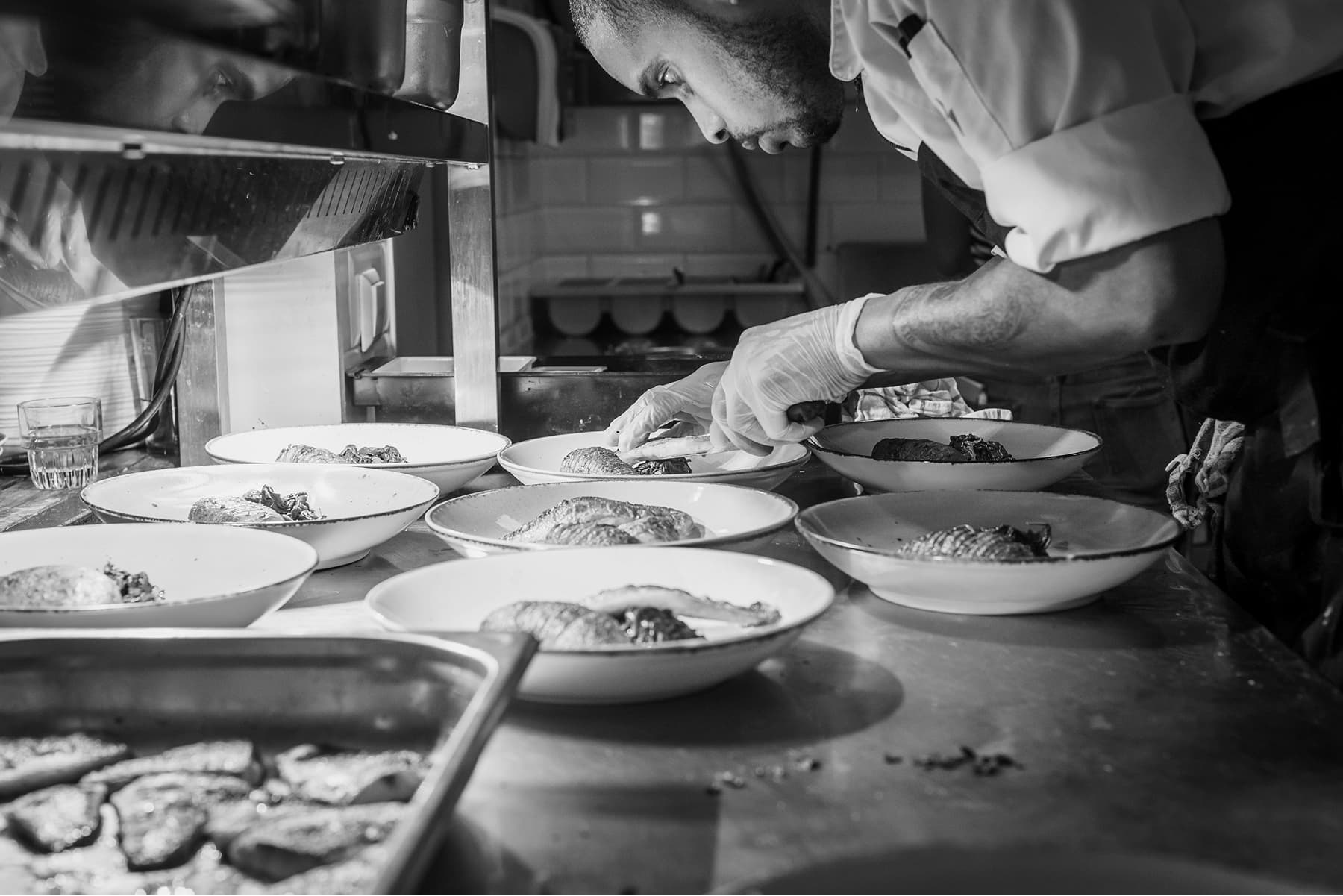
The first is food as the hero: individual dishes, specials, and seasonal menu items photographed at their best. This is the content that most restaurants default to, and it works, but it should make up no more than half of what the account posts. The second is process and people: the kitchen in action, the team at work, the prep that happens before service begins. This content builds trust and emotional connection in a way that dish photography cannot, because it shows the humans behind the food. 2026 data bears this out: posts featuring people consistently outperform food-only photography by 44%, a gap that has grown as feeds have become more saturated with polished but impersonal dish shots.5 The third is the customer story: reposts of tagged content from diners, testimonials, and moments from the dining room. Research indicates that user-generated content outperforms polished professional photography by roughly 40% in engagement, because it feels genuine to the viewer rather than promotional.4 The fourth is the local and seasonal anchor: content tied to the neighbourhood, the market where suppliers are found, the events on the local calendar. This content earns saves and shares because it is specific and useful to people in the area, not broad and generic.
Working from these four categories, a restaurant can plan a week of content without staring at a blank screen each morning. Monday might be a dish photograph from last week's service. Wednesday might be a Reel of prep from Tuesday. Friday might be a reshared story from a regular. The planning decision becomes a category rotation, not a creative act from scratch each time.
The batch photography session
The single most effective change most restaurant owners can make to their Instagram consistency is dedicating one photography session per week rather than trying to capture content during service. Shooting during service is reactive, produces inconsistent results because the lighting and pace are unpredictable, and adds pressure to a period that is already demanding. A thirty-minute session before service on a Tuesday morning, in good natural light, with three or four dishes plated specifically for photography, produces enough material for the entire week's feed posts.6
The key to making this work is building a visual asset library, a folder in Google Drive or a shared album on a phone, where every usable photo and video clip is stored and categorised. A restaurant that does this consistently for a month has thirty or more usable assets available at any point, which means a missed week of shooting does not immediately create a gap in the posting schedule. The library acts as a buffer against the weeks where service is relentless and no one picks up a camera. It also makes scheduling faster, because the content already exists and the task becomes selection and captioning rather than creation.
Video needs to be part of the capture session, not an afterthought. Reels reach roughly twice as many non-followers as static posts on Instagram, making them the primary tool for growing beyond the existing audience.7 Restaurants with a consistent short-form video strategy see audience growth two to three times faster than accounts relying primarily on static posts.5 A thirty-second clip of plating, a time-lapse of the dining room filling up, or a ten-second pour of a cocktail requires minimal additional effort during a photography session but produces the format that the algorithm distributes most widely. Restaurants in food-adjacent verticals consistently outperform other categories in Reels engagement, with food content achieving some of the highest rates of any industry on the platform.7
Scheduling removes the daily decision
Once a week's content exists in the library, the next step is to remove the daily posting decision entirely by scheduling everything in advance. Meta Business Suite, Instagram's free native scheduling tool, supports feed posts, Reels, Stories, and carousels, and allows scheduling weeks ahead. For most independent restaurants, it is the only scheduling tool they need. A Thursday evening planning session of forty-five minutes can produce a fully scheduled week of content, meaning the account stays active through Saturday night service, Sunday brunch, and the Monday recovery without anyone touching the phone for social media purposes during those periods.6
The structure that works most reliably for restaurants is three feed posts per week, daily Stories, and one Reel per week as the minimum baseline. Stories are the easiest part of this to maintain because they are ephemeral and require no visual polish. A photo of the day's specials written on the chalkboard, a quick poll asking followers to vote on which pudding should make the Sunday menu, or a fifteen-second clip of the kitchen team setting up are all legitimate Story content that takes two minutes to produce and post. The 24-hour expiration of Stories means they also create a natural cadence: there is always a reason to show something today that will be gone tomorrow, which makes them the right format for daily updates without requiring the same level of creative thought as a feed post.
Does user-generated content count as a posting strategy?
Treating customer-tagged content as a genuine part of the posting strategy rather than an occasional bonus significantly reduces the content creation burden. When a regular photographs their dish and tags the restaurant, that is ready-made feed content with better authenticity credentials than anything the restaurant produces professionally. The practice of actively encouraging this through small prompts, a note on the menu mentioning the account handle, a card at the table, or a line in the booking confirmation asking guests to share their experience, builds a stream of incoming content that keeps posting possible even in the weeks where the photography session does not happen.4
The discipline this requires is a response workflow: checking tags daily, requesting permission to reshare where it is not already granted, and crediting the original poster in the caption. Most guests are happy to have their content featured, and the notification that the restaurant has reshared their post frequently brings them back to engage with the account and share the repost with their own followers. Building this into the weekly planning session, treating incoming tagged content as a content category in its own right rather than an occasional opportunity, is what separates restaurants that use UGC consistently from those that notice it occasionally and then forget to act on it.
Stories keep the account alive between posts
Stories deserve more deliberate planning than most restaurant owners give them. Because they disappear after 24 hours and feel informal, they are often treated as an afterthought rather than a strategic asset. In practice, Stories are what keep an account visible to existing followers between feed posts, and they generate the kind of daily touchpoints that build the familiarity a restaurant needs to stay top-of-mind with regulars.4
A simple Story routine for a restaurant might look like this:
This takes ten minutes across a day. The interactive elements, polls, questions, and the "add yours" sticker generate direct audience engagement that Instagram's algorithm reads as a signal of account health, boosting the visibility of feed posts that follow. Restaurants that post Stories daily see engagement lift of around 27% across their overall account activity, because the account registers as consistently active rather than periodically present.5
Consistency is the competitive advantage most restaurants ignore
The restaurants that stay consistently active on Instagram over twelve months are not the ones with the best photographers or the most creative team. They are the ones that reduced Instagram to a system simple enough to survive a Friday night service. That is not a low bar. Running a system through the genuine chaos of a busy kitchen requires it to be genuinely simple, which is why the approach described here has as few moving parts as possible: four content pillars, one batch session per week, one scheduling session per week, and a daily Stories routine.
The compounding effect of this approach is real and measurable. An account that posts three times per week for a year accumulates 150-plus pieces of searchable, indexable content. Its algorithm classification improves over time as Instagram learns the account's audience and content type. Its follower relationship deepens as regulars see the team, the kitchen, and the story of the restaurant rather than a periodic flood of promotional posts. The gap between a restaurant that does this and one that does not grows wider every month, because consistency compounds in the same way that inconsistency does. The restaurant that has not posted in three weeks does not pick up where it left off. It starts recovering.
The content a restaurant needs to sustain this system already exists inside its four walls. The kitchen is full of it. An AI social media assistant that works from a restaurant's own footage, identifying the strongest frames from the batch session and enhancing them into on-brand posts, makes the weekly planning session faster without making the content generic. The starting material is the restaurant's own food, its own people, and its own story. The system turns that material into something that stays visible online long after the service is done.
Sources
Footnotes
Instagram public professional accounts indexed by Google since July 2025, enabling Reels to appear in local search results, TrueFuture Media↩
Posts featuring people outperform food-only posts by 44%; restaurants with consistent short-form video see 2-3x faster audience growth; daily Stories posting lifts overall engagement by approximately 27%, Restaurant Marketing Statistics 2026↩↩2↩3
Reels reach advantage over static posts and food content engagement benchmarks, Social Insider↩↩2